Wednesday, 14 October 2020
Minecrafting
Friday, 17 April 2020
It's the end of the world (as we know it)
Nevertheless, this has created an opportunity at least. Yeah, it's a horrible thing what's happening and it would be better if it didn't, but it's giving us lessons, really important ones. And I'd like to mention some of them, as I think about them.
1-In lots of workplaces, it is possible to work from home. This one is written from a privileged standpoint, of course, shops and industries and the primary sector is not included in this. But there's currently a lot of new jobs, based on services, where we have been forced to go there every day and stay there for a lot of hours, to be present just out of a certain old fashioned panic that if we don't have someone breathing on our neck, we won't work. Well, not the case, clearly. At the same time, there's meetings and such things that in the end were not as necessary as we thought and can be shortened or eliminated without that much problem. For sure in-person contact has its advantages too, but this should really made us rethink how we work, and try a more balanced system where maybe we can easily be home at least half of our time.
2-Really essential services are the primary sector, the food shops and the cleaners. Jobs like working in a supermarket or cleaning offices and houses should be better valued and paid nicely. Also better considered.
3-Healtchare must be public. Private healthcare that depends on profit has no advantage in dealing with this, because it requires a lot of resources and hours and it's overall too expensive. Also, public healthcare must be well-funded and have enough resources. And given this learning, I would go further: Just straight up ban and nationalize private healthcare companies. Also, if you're all for private healthcare and vote for parties that are against public one, it's only fair you refute any treatment nor help in public hospitals and facilities. Or reconsider your vote next time.
4-Capitalsim doesn't work. The system is totally broken and this crisis is showing its worst sides. Under pure capitalism, we would need to continue working right now, as we die left and right. Under pure capitalism, now people should just go hungry and starve and die out as they cannot work. Under pure capitalism, any business that was unable to function for this period should just close and disappear, or leave its employees to die out at least. This is neither a sustainable model nor a model we should want to keep. This needs to go. I'm not advocating for communism, but we must get rid of the idea that the market is great, when the truth is the market would see humankind destroyed in order to keep benefits. We have seen this before, in the people that lose track of the real world and require workers to do extra hours to finish a project that will ultimately have no meaning 2 weeks after completion. Well, I'm exaggerating a bit on this example, but this same attitude is the one where some manager considers that maybe people should just work, because the company needs it, without realizing this means people will die.
5-Related to this, we need to make people in power responsible for their actions. Managers who have disregarded warnings and asked people to work have killed people. Governments who haven't taken action once it was clear how serious the situation was and have not followed medical expert's recommendations are guilty of personally killing people. One thing is not knowing what to do, another very different is thinking that since your friend the banker prefers people to die than to close some of his business, you can allow it. Or allowing it out of some political agenda. This means you are killing people. And this is not the only situation when this happens: when a government allows banks to kick people out of their homes from unpaid mortgages, both the bank and the government are directly killing people. When a manager over stresses their workforce to the point of people having nervous breakdowns, they are directly killing people. When a rich bastard not only doesn't pay their taxes but also pressures the government to close public hospitals, they're directly killing people. No more fucking euphemism, if you do these things you're a killer, and you should not be allowed to get away with it.
6-Centralism doesn't work. Look, I think Spain is a failed project and I'd rather be left out of it. Maybe you don't think the same, that's fine. But what is undeniable, as we've seen in companies, countries and other organizations, is that when you centralize everything, when you try to manage personally more and more and more things, when you're further away from the real action separated by layers of responsible people, well, you have a less clear image of what is happening. In this crisis, hospitals and small towns or neighborhoods can know better what's the best actions to take. They can know better what resources they have, what do they lack, what to do. So you leave them be, unless they prove to be doing a bad job out of it. Then, if they lack things, if you have organizations over them you can manage that from such a higher level, and so on. But when you try to, basically, micromanage everywhere, that doesn't work. So let's not do that. From a government point of view, I believe regions should be more independent and able to take their own decisions, since they tend to know better their own needs. For example, now Spain has declared we can go back to work. This is idiotic and will cause deaths as the experts are saying (see point 5), but I'd say that for some regions it may be OK. However, should be managed region by region as I said, to see which ones can do it and which ones cannot.
7-Spain's traditional parties plus the right wing parties are useless. Right wing, we know, they're here to steal and lick their rich friend's anuses, and people can die as far as they care, we all know that. However, I hope it also helps to show that PSOE is almost as bad: they militarized the crisis instead of giving funds to healthcare, and since their members are professional politicians that don't know how to do things but know how to get paid from public funds, we've had the situation were resources are not reaching the people, or they buy the wrong things and millions are wasted, plus time is lost.
8-Left-wing parties do not deserve special protection just because they're considered left-wing. We made this mistake before with PSOE, letting it do things that were not left-wing just because we labelled it as the left-wing party. So, the same applies now to Podemos. They're part of the government even if they're not big enough to make some changes. I understand they're not able to criticize some of the government actions without creating a conflict, but that doesn't make them untouchable. We should criticize the fact that they let military to lead this crisis. We should criticize that they're not protecting workers by allowing people to work. And we should criticize their silence or their praise to the current government, when it's not right.
9-USA, UK and Brazil, as very capitalist and right-wing countries, are far from the worst of it, and it will be a massacre in there. Spain is already one because of several of the mentioned points, and forcing people back to work now will kill and numbers will grow again.
10-Catalunya's proposals have been a bit more smart than Spain's (because duh, it's not very hard to be), but far from effective, and one of the involved parties has also been de-funding public healthcare, and that's something we should not forget either.
There's plenty more things I could say, but politically speaking I find these are quite relevant...
Thursday, 29 December 2016
Gangneung: Reminiscenses Of Lund
I did visit it before, so I already got some ideas about the place, but living here has showed me a bit more of the life here.
And it heavily reminds me of Sweden....or to be fair and more precise, of my particular experiences while in Lund, Sweden.
First of all, most apartments have wooden floors and floor-based heating. This is a small but important detail. Because of this, most apartments also have an entry area where you leave your shoes and jackets. This is rather common in winter areas, but this in Korea is very very similar to the same thing in Sweden, with different tiles and height, to really delimitate that you should not step on the wooden floors with the street shoes. The apartments's style is also familiar, with thick walls and windows, quality details and big living room/kitchen areas, and then one room or more apart, a distribution based on big spaces more than in compartmentalising the floor.
Then of course there's the weather, which is not as cold as north Sweden by far, but it is similar to the weather in the part of Sweden where I lived (although Gangneung is colder than Lund), more temperate but still pretty cold, where it snows during winter. By the way, it snowed already a couple of times, and it was cold enough that it accumulated and lasted for 2-3 days each time, plus in the mornings there were ice layers everywhere. This of course poses problems, especially because I move around with a bike, and I need to be careful about this ice....
Moving around with the bike is also a nice reminder. It's not like I don't move around with a bike in Barcelona, but here in Gangneung the town is small enough to allow using it almost everywhere, while streets and roads are, if not prepared, at least open to the fact that people use bikes around. Adler was also small enough to use a bike, but the reality was that the culture there was unused to this so nobody did it...It is true that Gangneung has way too many cars, and cars are the transport of choice of most people, there's not a lot of bikes going around....but there's some. And again, this is from my point of view, and both here and in Sweden I had similar experiences while using a bike (like going towards some party in a bike, going shopping in a bike, crossing snow with a bike, using a bike while slightly drunk, etc.), in part I guess because it's the two places I've been where it's easy to have your own bike, and it's not stressful.
This brings me to the security thing...I can leave the bike unlocked in the street or just with a locked wheel and I know no one is going to steal it. I love this feeling of security, not even Barcelona has this....here I know I can have my bike to move around and I will probably be fine, and it's not a source of worry. The same applies for using mobiles on the street or having money in the wallet. After Rio, this is incredible and allows me to be a lot more relaxed and calm at any moment.
Internet is also pretty similar, with rather good speeds, although I believe the intercontinental connections and the state censorship that is applied on websites slows traffic down considerably depending on what you're trying to access....
Finally, there's also the social atmosphere. One thing in Korea that is pretty awesome is that all English teachers need to be natives, so from an English-speaking country. This, plus the Olympic travellers, means there's a big group of people from all around the world, even in such a small town. So it feels you're meeting people from lots of places, and because of that there's also a "party" atmosphere, in a way.....I really like this atmosphere, and in other projects there was also a certain feeling like this, but it was usually Olympic-related while here it's more open (well, in the sense that there's also this other group, the English teachers). There's even people who will be happy to meet to play board and card games...
Of course, there's also things that are not similar at all (starting from the population, not many tall and big, blonde, blue-eyed people in the streets here...)
For example, the culture here seems a lot more closed to foreigners and changes, and there are social issues that are light-years behind in Korea compared to Spain (and let's not compare it with Sweden which is more advanced that Spain in plenty of those...). There's a big cult for looks in here, and women are still treated really bad in general...also, work follows a very capitalist model, where you cannot get sick and stay at home to rest (which is worse for the company as well because you're less productive at work and you can get other people sick). SIM cards and phone numbers are ridiculous hard to get. The food is evidently completely different, usually spicy even when they say it's not, or very sweet. There's plenty of dishes with lots of green vegetables, mushrooms and leaves(and rice, of course), and meat is common in dishes but not in big quantities outside barbecue places (and in supermarkets it's expensive). And as I already mentioned, traffic is very car-based, even for small trips that with a bike would be 10 minutes or less, and driving is rather aggressive and chaotic (but well, I was in Russia and Brazil, nothing new or worse than that, really) , with plenty of intersections that are rather badly-designed and cause waits for everyone involved. One surprise I got was that, in general, cars do not respect pedestrians, but they do watch out for them, it's just they don't give way to pedestrians unless they're about to hit them or so...
So yeah, plenty of differences actually, and more I have not mentioned...
Still, the atmosphere has a certain similarity for sure...
Wednesday, 17 December 2014
Natural Things
This is an evident problem because some things are fragile. or organized, or dangerous, and we cannot let him touch and grab them (and he gets mad when we don't let him do so, but oh well...). This means following him around and supervising what he does if he wants to walk around the place.
A few weeks ago I tried to show him xbox games, to see what he would do, and let him touch the controller so he would see things moving in the screen whe he pressed buttons. He was not that interested actually, and I don't know if he did fully grasp he could make things happen through the controller. He was happier biting the controller, and then going to the big TV and slapping the screen (which then we had to go and tell him no, he could only touch it softly...even if he tried more times and we had to kept telling no).
This made me think about tablets, phones and other new devices. In lots of modern technology, they defend natural ways of doing things. And our son clearly showed that it is natural that, if you see something in a screen, you interact with it touching the screen. Consoles have also used this concept with movement recognition (Kinect, Wii), in which you use all you body to do something. It's really a natural way of interacting with equipment.
Do you know what else is natural? Dying of appendicitis. Another example? Cyanide can be found in nature. "Natural" things are not necessary "good", or "better" than artificial things. Some natural things can be improved in a huge number of ways.
Interacting with technology has been evolving through the years, and lately everything has a touchscreen, some have voice-recognition, and some even have movement recognition. Some of these are based on science-fiction work (like the famous mobile air screens in Minority Report). And they look cool, and we definitely should think if it is possible to make and create ways to make it, becasue in some applications it may be useful (like 3D modelling in the middle of the air).
However, practicality should always be in mind. Touchscreens are good for mobiles, because they open space for the screen while allowing mobiles not to have a keyboard. They are good for saving space, which is an important trait in a mobile device. Tablets have a similar principle, if you want to easily move around with them and see videos and play point-and-click games, they're good. Nevertheless, touchscreens are not precise. If you need to select text, or press a small button, touchscreens suck. Because our fingers are thick and imprecise, and the only way they can be useful to select is if the thing being selected has, at least, twice the surface than your finger, not leaving margin for error.
Touchscreen in cameras? Terrible idea. Touchscreen in PCs? Even worse. Touchscreens in gaming? Really really stupid, outside point-and-click games with big thingies to click. The aberration that represents a Windows Server Operating System with touchscreen interface (when servers don't even have touchscreens)? Let's not even waste words...
Same applies to kinect and other movement sensors. To do physical activities it is a good idea, and for some party games as well. However, any shooter where you need to move yourself in front of a camera is a really bad one where you cannot reach immersion at all.
Ideally, communicating with technology is just a translation between what our brain wants to do and what the technology needs to do. the perfect communication would be to have thought-activated things that really do what you want them to do. This is actually hard and complex, so instead we use interfaces like a mouse, or a controller. The idea is to translate our thought into a minimum of actions (like moving muscles). A touchscreen can be a good interface, but the mouse is a lot more precise and with less movements. If you want to select text, the mouse is almost perfect, because it offers a huge amount of precision and control in a flat area and using a very limited number of muscles. For example, if you want to apply the the idea "select text", you need to slightly move your hand until the cursor is on top of the text, and then press slightly with one of your fingers on the mouse button, while again moving slightly your hand and maybe your arm. The more muscles you need to use to translate ideas to the machine, the worse the interface is because the brain needs to do more work and use more parts to transmit simple ideas. Therefore, mouses to use in the air, while you move your hands, are idiotic unless you want to manipulate 3D objects. Since computer screens are usually flat, moving your hands in 3D is stupid. you will end up moving them in a 2D plane in front of the screen, and for that we already have the mouse and without needing to raise arms. To select text with a 3D mouse or system where you wave your hands in the air, you need to move all your arm until the hand is in a position that the computer recognizes as being on top of the text, then signal with the hand by moving one or more of your fingers quite a lot, and then waving your arm around. If the way to select is a touchscreen, the process is quite similar. This is quite less efficient than using the mouse on top of the table.
The same applies with games. The Xbox controller layout is almost perfect in allowing you to do plenty of actions,including moving two joysticks while pressing buttons. Changing that for a touchscreen or for a movement detector is replacing small finger movements with full body and arm movements, and removing the chance of activating different buttons or actions at the same time.
Again, I'm not saying in all situations it is stupid to use these "new" interaction technologies. I'm just saying that, for example, if you make a dancing game, by all means use a movement sensor. If you're making an RPG with a first person view, don't bother and give me a controller with 10 buttons that I don't need to look at to know what I'm pressing. Just because you have a movement sensor, don't force it on everything you do.
This is especially annoying regarding bad quality touchscreens for devices that have screens too small for fingers. For example cameras and video cameras. Lately some of them have touchscreens to interact with them, when a small joystick or 4 arrow buttons would be extremely more efficient and easy to use.
And then there is this trend to force touchscreens on normal PCs or even on servers (again, why the hell did you do this, Microsoft??), which needs its own category of stupidity, because normal stupid look like genius by comparison...
Monday, 12 May 2014
Double Fine And Broken Age
Kickstarter is a website that lets you donate money to projects you believe are worth doing and that lack funding. At the time when Double Fine was considering its future, Kickstarter had done some small campaigns, with only one or two very successful ones.
Double Fine decided to make their fans prove what they were saying and proposed to fund a new graphic adventure, using this video to promote the bid. The initial bid was 400.000 dollars, which is quite a big sum, of course...
For some weird reason, I managed to find out about this the same day that they put this video up. I got really excited about this, and I went to check the Kickstarter page. I wanted to donate money so a small, great game company could basically do whatever they wanted with no publishers messing around the final product.
When I entered the page, donations had reached 800.000 dollars. The 400.000-mark had been crushed in less than 8 hours. The Kickstarter server was crashing and didn't handle the load well. In the middle of this, I managed to make a small donation. I explained the story to Olia, and she got excited about it as well, and we started to check the page and refresh to see what was happening. In a few minutes thousands of dollars were being donated to the project. Everybody was crazy about it, the comments of the people participating were awesome, and checking twitter accounts of people from Double Fine and Tim Schafer, they couldn't believe it either.
We actually saw it arrive to 1.000.000 dollars. It was amazing, and less than 24 hours had passed. It felt like a special moment of partying with the world.
After this, the rhythm of donations slowed down, and days passed without big donations. However, in the month that the campaign lasted, they managed to get 3.3 Millions.
I forgot about this for a long time, and after I while I read that even with that money they had production problems, because they made the game way too big. In the end they divided the game in two, and decided to sell the first part and then produce the second part (that would not require another purchase).
The game came out just recently, and since I was a backer, I had the right to get a copy. I didn't install it in a long while, but some weeks ago we finally tried the game that we helped a little bit to make.
We haven't played much, for obvious reasons....but we can already tell: Broken Age is awesome. The animation, the drawings, the voice acting, the music, the little details...it's incredible, it feels like playing inside of a painting.
What remains to be seen is if the plot and the puzzles are also top notch since we haven't played much....but so far the feelings we're getting are pretty good.
The most important thing about all that is that it has shown that publishers can be very, very wrong about their opinions. Sure, publishers know a number of tricks that increases your chances of being economically successful, and they may correctly guess that some projects will fail...but this is not an exact science. Publishers are also usually ruled by rich people with very fixed ways of thinking that prevents innovations, or just adapting to new times. And now there's lots of chances to make something awesome and popular, that innovates in things that nobody has dared to try, and we're free to put such ideas to popular vote in form of donations.
Anyway, Broken age seems like a great game, and supporting it guarantees that Double Fine will keep producing imaginative, incredible games.
Monday, 25 November 2013
World-Building and Bioshock
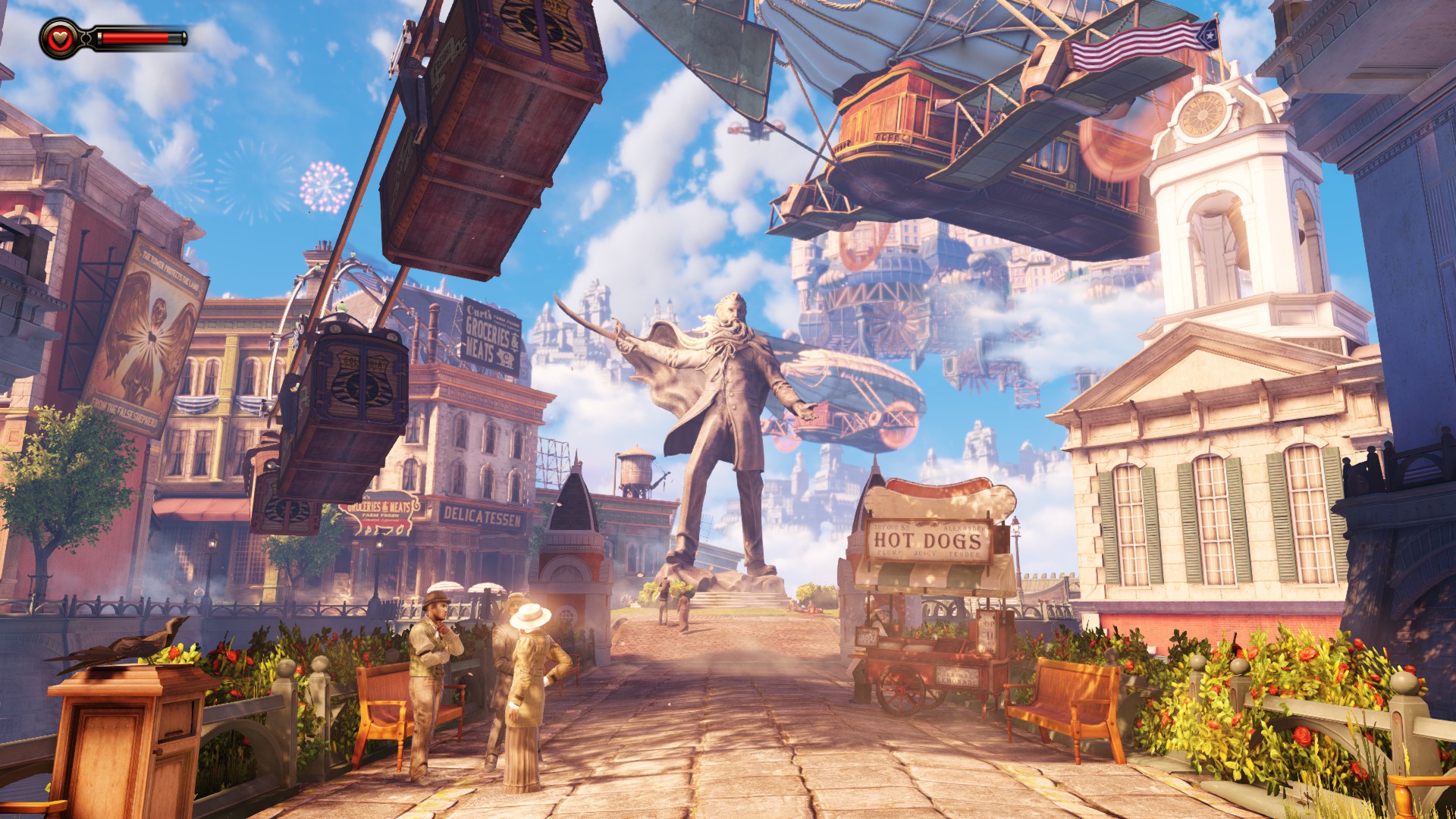
I heard and read reviews about this game, and there has been lots of posts, screenshots and gifs around the internet. Just form the beginning, the game can catch your eye by looking like this:
It's not only graphics, which are really good...is the world that they're showing you. A world of fantasy, a floating city with rails connecting sections, huge statues, a thriving population, shops, houses...all this mixed with steampunk technology. It looks awesome.
However, this is not all, by far. I started playing and was immersed in a complex and weird story, starting with an introduction that takes a long while before you even fire a single shot (apart from firing in little fair tents that have games of marksmanship). This introduction is incredible, makes you feel inside this place...but more important, makes you believe such a place exists.
Maybe a great part of what makes art amazing is its ability to create worlds that do not exist. You can see that in movies, in literature, in dance, even in music and paintings...they can show reality, but they can go further than that, and show you the realms of the imagination. These realms can be amazing, scary, dark, cheerful, modern, dream-like, happy...and in these realms you can make your own rules, in history, in economics, or even in physics.
Games are art, even if not recognized by everybody, and good games create such worlds while putting you in control of someone or something inside that world.
When these worlds are created with art, it is very important that they're created well. A bad painting, that messes up proportions just because of lack of skill will remind you that it's just a painting. You may enjoy it, but reality will point out the problems it has, and you will return to your own world much faster. You can apply that with any other world-building work.
That's why world-building is very important. The most clear example you can find are novels. Novels, by its extension, have lots of time to create a world. It's hard to put a lot of details in a movie that last 90 minutes, but in a book of 500 pages you have time to develop a universe inside. Books have a lot more margin to define this world, which can be slightly or a lot different than our own.
And nothing will make a story lose its appeal as a badly-build world. I believe Terry Pratchett (or somebody commenting on his work) once mentioned that his created city of Ankh-Morpork submerges you in it because you don't need the protagonists to be there for it to work. If the hero was not walking around, doing hero stuff, its inhabitants would still work, and live, and eat food, and buy things, and all that. That created world is so rich that when the heroes stroll around it, it's easy to believe you're there with them. It makes sense internally. Does it matter that magic is real, the earth is flat, and that the sun orbits earth in there? No, because its consistent with itself, and it works...if you imagine a world described as it is in the books, you can see that it's solid, it has its own life.
Now, that may sound blasphemous...but let's have a look at Tolkien. Let's concentrate on Gondor. What does exactly that region do? It basically fights the Dark Lord, permanently, always at war for who knows how many years, all their people soldiers, all their people closed inside their walls. Now, Tolkien has great world-building skills, and this world is rich and varied. However, Gondor in particular makes little sense, and personally that's why it seems also like the most boring part of the books, when Gondor defends itself or attacks (when Rohan helps it's fun, but while there's only Gondor, it's boring), because I cannot help but wonder how the hell it's still standing, or how people manage to live there.
Now, you can maybe say that Tolkien explained these details in some other work, or that some things are implied without being said...however, I still think that Gondor, in the Lord of The Rings, is not well made, and it fails to stand on its own logic. People would not live there if it wasn't for the plot.
There are lots of lesser books that nevertheless grasped quite well this concept of World Building. For example, the Belgariad and the Malloreon are not greatly written, or very original...but its characters are much more alive than some of Tolkien's characters, and there's a lot of details to simple facts...like the fact that, if somebody's going to wage war, that someone is going to provide food for the troops, and then if you invest in some cheap food, you may get huge rewards...or, that a moving war front needs a constant supply of materials, which needs to follow you and form a chain with the origin of the supply. That gives a lot of coherence to the book.
Before I mentioned that movies do not have as much time for world-building...but that does not mean they should not have a good one. The easiest way to see that a movie is full of bullshit is if the world is rather inconsistent with itself. Take Star Wars prequels, where in a galaxy of millions of planets, that have billions of people and species in each planet, there's like 6 characters that are always present when something important occurs, no matter the place. That's laziness right there, and returns you to reality fast enough to scream bullshit.
Games are in a middle term, taking longer than movies but not being able to say as much as books do. In games, immersion is very dependant on that world-building. The first Bioshock game was impressive, the water rendering was amazing, physics involved in its movement were pretty awesome, and the introduction was very surprising...however, the supposed "city" did not seem a city at all. Even considering that an underworld city needs to have small corridors, it never felt like corridors, just a single endless corridor that railroaded you from place to place, with a few exceptions where you had a couple of different rooms to visit. Also, everybody was an enemy. For a city that was supposed full of people, even after a disaster, it felt empty, lifeless....and the fact that the corridors were not a labyrinth, or a grid, removed the feeling of being in a city, putting you back in reality and saying "Game with linear design".
Bioshock Infinite, in just the first hour of gameplay, shames the first Bioshock by showing how it's done: It moves you to a great city in the sky, with people, with attractions, shows, shops, toys, children and adults, subculture, rebellion, social problems, radio shows, music.....in general, life. You can see that people live there, you believe so, because it makes perfect sense, internally. The game still has a linear design, but by defending these flaws as part of life in there, such as the fact that private houses are closed, or that flying streets sometimes are not connected and may have timetables or change depending on the moment, makes you ignore the fact that you're basically moving from point A to point B in a straight line.
You feel in a city, with people living there, and you see that it does not require your character for it to make sense.
This is world-building when done well. Great stories and great art will always have great world-building. And Bioshock Infinite does it very well indeed....
Sunday, 15 September 2013
Metal Gear And Other Classics
The graphics of this game are weirdly awesome. They used real actors and rotoscopy, so the faces are quite alive. The train is rather nice, with lots of luxury touches. This game costed a lot of money to make, and was considered a great game, but did poorly in sales, which helped to end the development of graphic adventures.
I love trains, specially night trains, with their private compartments and bunk beds and all that....and this game gives an awesome impression of being in one. It also puts you in that time period, with loads and loads of extra information, like newspapers, that are not necessary for the plot, but add to the atmosphere. The clues and actions to take are not evident and require you to eavesdrop, sneak around, and use your brain. The game also uses a very unique system of representing real time, with actions happening at certain moments independently from the fact that you are there to see them, and you don't save the game, you can just go back in time to fix something, specially if you fail at some point or do something stupid (and the game gives you freedom to prematurely end it in lots of ways) .
The Last Express is a great game, and it's a real shame that because of its failure to gain money no more similar games were made (a sequel was cancelled, and the game ends leaving some questions unresolved...although it could be considered an ending nevertheless).
Commandos is a strategy game, developed by a Spanish game studio and set in the second world war. You control a small number of very specialised soldiers, and you need to perform missions in which you need to infiltrate German areas to perform key tasks that will help win the war.
In this game you need to sneak around, distract patrols, deploy bombs and other tasks while being undetected, to avoid reinforcements. The graphics area really beautifully done, representing several areas in Europe and Africa. The game is incredibly advanced for the time and for being Spanish, and it's really addictive. You always need to keep all your soldiers alive, and you need to combine them in smart ways, analysing patterns of patrols and using your resources very carefully. It's a very difficult game, but it's totally worth it. There's a second and third part, which are even more detailed, with more options, more things to consider when sneaking around (which makes them even more difficult), and with real 3D scenarios (in the first game you only had a 2.5 perspective that was impossible to change).
The highly addictive and hard missions are combined with explanations of the war's progression and footage of that time. Everything adds up to one of the best strategy games ever, really intense and addictive.
Carmageddon is an (in)famous game. You drive a car, and you kill people and other cars while "racing". You get points and time by doing these things, and you get even more points and time the more brutal the killing has been done. There's no plot whatsoever, and you just go through several stages, gaining ranks and obtaining improvements while stealing other cars.
This game is very, very violent....but so over-the-top violent, that you cannot take it seriously. Even the slightest touch at the lowest speed makes people to explode in a rain of blood and guts, accompanied with the corresponding sound effects, while you get extra points for "artistic impression" and other such things. Even the game itself makes it clear how stupidly over the top is, by showing you a severed hand when using the mouse, and by asking if you're sure you want to go back to the real world when quitting.
Each stage can be completed by killing all civilians, by wasting all other competitors or by finishing all the laps and checkpoints in the stage. Usually, the best way to finish is by wasting competitors (completing the race is boring, and killing all civilians is an insane task when there's usually around 600 per stage and they don't show up on the map). Therefore the main gameplay is to trash other cars, which is not as violent...however, the main selling point, and the thing that was used to try and ban the game in some places was the "killing civilians" part, of course.
The graphics in this game are not that great, the cars are 3d models and the civilians are flat textures moving around. The moment you let an opponent go far away, they become really hard to differentiate from the rest of the environment, and in general everything is a like a big, bright mess.
Even with all this and with no plot, this game is absolutely awesome. It does so many things well, it's impressive. The soundtrack is based on heavy metal riffs and sounds, reminding me of Fear Factory style. The driving is just plain fun, with physic laws be dammed. Trashing other cars is also lots of fun, and the extra pedestrian killing while this happens is just brutal with heavy black comedy style. I always picked the girl driver (because the guy looks retarded), and to hear "sorry!" while splashing the insides of some pedestrian on the road was always so stupid that it keeps being funny.
This game did so many things right, it will always be mind-numbingly fun. Just to take your highly-modified car, accelerate and frontally crash against an opponent, sending both of you flying for thousands of meters and falling on top of some unlucky bystander.
I've been playing these games in my laptop. However, I've also been playing a little bit on my Xbox, where I have finally finished Metal Gear Solid 2, and I've started the 3rd one.
Metal Gear Solid was a game for PlayStation. It follows the plot of two older games, in which the main character, Solid Snake, infiltrates some installation to kill terrorists. This newer version for PlayStation had the same initial plot. The principle is very basic, but things get complicated quite fast, and the plot gets very complex, with interesting characters, while mixing philosophical ideas and in general trying to pass a very anti-war message and hating that you have to defeat some people (while doing pretty awesome war-related things...and somehow it all works and makes sense).
I still remember the first time I played Metal Gear Solid, for no more than 15 minutes I believe. After that, I bought a PlayStation and this game right away, to be able to play it at home (and at that time, that meant spending 90% of my savings...just after those 15 minutes of play). The second and third part were already made for PlayStation 2, a console I never bought, so I had the trauma of not continuing with the story.
The Metal Gear games are very movie-like. They have great voice-acting, intense action scenes, camera effects and other tricks like that, while sometimes breaking the 4th wall and talking directly about things that the player is doing (and not the character). Their plots are incredible, very complex and plenty of times totally ridiculous, but in an awesome way.
Recently, they made a special version of metal gear solid 2 and 3, plus another one called Peace walker, for the Xbox. I bought this HD version quite fast, but I didn't get around to play them until recently.
Metal Gear Solid 2 is, in a way, a retelling of the first game. The plot is very different, but there's lots of things that are very similar, and that's an actual plot point. The whole game can be easily understood by the following fact: The game's creator didn't want to make this game, he was forced to do so by fan's request, and the game is the way the creator punished the fans.
I'm not saying the game is not good...but, for example, during 90% of the game, the player controls this other character, not Solid Snake, who is clearly not as good. Meanwhile solid Snake is doing stuff around you too, showing how awesome he is (and you cannot control him). That's a clear response to the fact that fans wanted more solid snake. Another poke is the fact that you don't seem to control the actions in the game, you just do as you're told, mindlessly, and the game insults you for that.
There's other things and plot points that help to give this message. The game is still really good, with a difficult story, very confusing and ridiculous sometimes, but interesting. The gameplay is the same as the previous game, with some extra actions you can do now (like aiming in 1st person with any weapon). You still need to sneak around, distract and avoid guards, and such things. However, it's true that it's important to know these facts about the creator before playing, otherwise you could get annoyed about it.
After finishing the 2nd game, I finally started the 3rd. I haven't played much yet, just a little more than one hour, but I can already see that the 3rd one is incredible. It's much better than the 2nd one (I guess this time the creator did not mind), with important changes in gameplay. The most important overall change seems to be that this one explains a story that happened in the past, and instead of controlling Solid Snake, you control his "father" (well, Solid snake is a clone). In just one hour I got quite an awesome feeling, kind of like a Bond movie (after all, the game has an introduction, a break with bond-style credits, images and music-including a female singer, dream-like images and lyrics that vaguely reference the game's name-, and then the real game starts).
One thing it's true about these games....the cinematics are a little too long. It is nice to see a story develop in its own pace, but sometimes you play for 10 minutes and then watch a 60-minute cinematic. It also does not help that you cannot pause them, which makes it annoying since you cannot take breaks to, for example, just go to the toilet. Playing the 2nd game I skipped one or two by mistake, just trying to pause the game.
However, it's also good to see a game that centres itself in the plot, and makes sure that the acting, the graphics and everything else makes you forget you're the player and submerges you into a different world. Even the first game achieved that, and made you forget that the graphics were very simple and the faces were not even moving while talking, they had a fixed expression. When a game makes you forget these things and the memory you have of it is of action-packed scenes, dialogue between people, and a complex, interesting story, you can tell the game is really really great. All metal gear solid games I've played so far achieved this without problems.
And that's all for the moment. We'll see how much more waiting will we do....
Wednesday, 17 July 2013
New Graphic Adventures
Made mostly by indie companies, these new graphic adventures may not be innovative regarding gameplay, but they transmit a similar feeling as the old ones, using today's graphics.
In the past months I have bought (always important to buy games if you want similar ones to be produced in the future) and played some of them. I have not finished them all, but all of them seem to be really great. I'd like to comment on a few of them:
Deponia: This is the first game I found in GOG that was mentioned as a very nice and new graphic adventure, while being funny like the original ones (Monkey Island, Day of The Tentacle) or some others (like Discworld). I was afraid I would find it childish or stupid, but there was an offer for this game, so I decided to get it and try it.
The game puts yourself in Deponia, a world made of trash. You're Rufus, an idiotic young guy who invents all kind of things, usually resulting in injuries and mayhem. He wishes to leave Deponia and reach the Elysium, a futuristic floating palace that has no contact with the Deponians. After one of his latest inventions, he ends up causing Goal, a girl from Elysium who is exploring the planet, to fall into Deponia's surface, rendering her unconscious. From this point, Rufus will try hard to make her recover from her fall and bring her back to the palace together with him.
First, the graphics are rather awesome. Everything is made out of 2D drawings in high resolution, and I believe the animations are also very nice. The music is good, without being specially memorable. The gameplay is simple and traditional, point and click style, and you don't have any inventory limitation (which is also traditional and funny sometimes, considering the amount of clutter you carry around). All this is technical stuff, and even if it is nice to have good graphics and good interface, the most important things are other ones.
Graphic adventures are usually based and evaluated on their plots and their puzzles. Deponia's plot is a kind of traditional "Distress Damsel" plot, but it is well executed. The best part are the characters, clearly defined and interesting. The world setting itself is quite weird, impossible to actually be functional but still interesting. You're curious to learn all the little details of this society, and as the plot advances, you want to know what will happen next. The main character is idiotic, but he does try to do good things, even when making a couple of bad decisions.
The puzzles themselves are rather hard. The logic behind them is quite twisted, and some particular ones are too obscure or illogical for my taste, it's hard to think that certain actions will work as the solution of a particular problem. Nevertheless they are interesting. Mixed with the normal puzzles, there are sometimes "mini-game" puzzles, which you can skip if you want but that are usually very interesting, while possible to do.
The humor in this game is ok, maybe not very smart, or maybe not that good, but good enough that I enjoyed it while playing. Comedy is a very subjective thing, and evidently it's not the same as some of the works that advertisements says this game resembles (like Discworld), but it's still good.
The game ends in the middle of the action, since this is supposed to be the first out of 3 games, but I enjoyed it very much in the end. Since I wanted to know how the story continued, I got the second part too.
Chaos on Deponia: This is the second Deponia game. It has mostly all the strengths and weakness of the previous one, with a few differences: First, in this game we see more of Goal, who was unconscious most of the time in the previous one, and we can get a better idea of her character. This makes her more interesting, before that we didn't know anything about her. Some other characters are given also more definition, and the plot becomes more complex and important. All this is good. The bad parts of this game are that some jokes and puzzles are...cruel. They make the main character a stupid mean person, while during the first game he was just stupid, but with good intentions. Some things are not really funny, even considering black humour, and I didn't like that part. I will talk about later, but Harvey's New Eyes manages to do cruel things while making sense, being funny using black humour, and keeping the characters interesting. This one does not achieve such things. Still, the plot remains interesting, the puzzles and worlds to explore are quite nice, and I definitely want to play the third and final part, whenever they release it.
A New Beginning: In contrast with Deponia, this game has a more serious approach, while still having humour in it. The company that developed it is the same, but in this case they tried to made a morality tale, to give awareness about environmental problems. However, the game does not feel preachy, and is interesting and compelling.
I haven't finished this game, but what I've seen and played has given me great sensations. The animations and graphics are all very detailed and high resolution 2D drawings, but not as cartoonish as with Deponia. The music is nice, the voice acting is good, and in general it seems a very good game.
The plot is interesting, involving time travel and surviving in a post-apocalyptic environment (at least, that's what I've seen so far). The puzzles are logical so far, while still being hard, and there is also an occasional "mini-game" puzzle, which are always fun to solve. I don't know if this will be true during all of it, but it's certainly worth to play.
Edna & Harvey: This is actually two games, "The Breakout" and "Harvey's New Eyes". I finished the Breakout and I'm currently at the beginning of the second one.
The Breakout explains the story of Edna, a mental patient who wants to escape the clinic, together with her imaginary friend Harvey, a bunny toy. Edna does not remember anything, but believes that she's quite sane. While trying to escape, she will interact with other patients and doctors, while remembering more and more about her past with the help of Harvey.
The graphics and animation in this game are 2D, cartoonish and very simple (compared with Deponia). However, the voice acting is very good. The puzzles are quite logical, which is surprising for an asylum, but it makes the game less frustrating, since what you need to do makes sense if you speak with the people around you. The music is great, very simple while managing to transmit lots of emotions, specially in the most serious parts of the game, or in the flashbacks.
The plot is amazing. You can guess what's going on and what will happen in the end after the first 5-10 minutes, but it doesn't stop it from being amazingly done. The gameplay makes you do things that clearly show that Edna is insane, and it's stuff that you do yourself, a nice touch to provide immersion. I liked a lot the humour used in the game, crazy and surreal sometimes. However, the game has quite serious moments, and it's not only some whacky adventure. The game is not very hard or long, but the experience of playing is really a great one, very recommended.
Harvey's New Eyes follows the adventures of Lilli, a little girl in a convent. There are elements in common with the Breakout, but it cannot be considered a direct sequel. It works in a very similar way, with improved graphics and animation. I have not finished the game yet, but so far it's also great, with lots of really really dark and black comedy. As I was commenting before, Chaos in Deponia has black comedy, but it seems cruel in there. In Havery's New Eyes, on the other hand, it fits quite well with the game, showing that something very dark and twisted is going on, in this world and in the twisted mind of the main character, who seems quite innocent while being clearly disturbed somehow. The gameplay also helps in the experience, in which you're doing terrible things yourself. The game so far manages to be funny while being very, VERY dark. Just as an example, a narrator explains everything that is happening in a kid-friendly and excited way, while you can see that reality does not match that description at all, like when you find an active bomb buried in the ground.
The Cat Lady: I have only played 5-10 minutes of this game, but I already love it. I read it's a psychological horror graphic adventure, and it seems exactly that. The graphics may not be the best, but they're creepy and beautifully detailed, also 2D drawing-based. The interface is a little weird, and the animations are a little bit clunky. However, the voice acting, the atmosphere, the music and images seem great, really really creepy. Another example of a game that should be considered "art", I believe. I'm at the very beginning, but as I mentioned, with just 5 minutes I got all these sensations, and not many games can pull something like that.
And that's all for the moment. I haven't tried yet Book of Unwritten Tales, which seems that it's also going to be very nice, and I need to really play and finish Harvey's New Eyes, A New Beginning and The Cat Lady. There's also the third part of Deponia in the near future, some other games that may not be a traditional graphic adventure but that I will try, plus the Double Fine new graphic adventure still in development, that may be really awesome, we'll see...
In any way, it seems that this "dead" genre (according to the big publishers) is still offering great titles that are totally worth buying...
Saturday, 6 July 2013
Faster Than Light
Some weeks ago I decided to get another indie game that I'd heard very good things about: Faster Than Light. It seems it was a kickstarter project, and lots of people really liked the idea and it became quite popular.
The basis of the game is rather simple: You have a spaceship with a crew and a certain equipment, and you need to escape a rebel fleet following you, contact your allies with important information and finally defeat the rebel mothership.
The thing that is rather refreshing for a videogame is that you do not pilot the spaceship, or aim its weapons. What you do is manage the tasks that the crew does, reassign power, select targets and weapons, and manage in general some basic aspects of the ship.
You start in a space location, in a randomly generated universe, and you need to navigate through several sectors. In each sector you need to jump between several locations, and in each locations you may have random encounters with other people and ships, you may have combats or you may shop and repair your ship.
Everything except the initial ship configuration is randomized. Even when you found the same event decsription twice, the outcome of the event may be different. Sometimes you have crew or equipment that gives better options in these random encounters, and sometimes you can get huge rewards or huge drawbacks.
Apart form that, you usually combat lots of ships, including rebels, pirates, slavers, automated droids and other aggressive species. You start with some weapons and some power, and by buying upgrades and equipment you need to add and distribute power to increase your ship capabilities, until you reach the final sector and fight the mothership.
The game is....well, hard. You cannot permanently save one point in time, if you continue playing after saving you will lose that save, and if you get killed, you need to start from the begginning. There are lots of options, and the wrong configuration can kill you pretty fast. After several games, you learn what works best, but still it's rather hard to get to the final sector. Once you're in the final sector, the Mothership, which requires 3 combats, one after the other, can quite easily destroy you in the first fight without you landing a shot, even when you were winning all previous combats.
Even while being a difficult game, and depending a lot on your luck given the randomness of the encounters, it's very easy to grasp the basics. It's also a game where a round till the last sector takes at max around 2 hours, which means that you can play 10 minutes, save, and continue later. This is a thing that I really appreciate, since you don't always have time to dedicate 1 hour to one game, and some games require that hour just to advance a little bit.
It kind of follows the idea of old games, where the difficulty was hard, and where if you got killed, that was it and you had to start again. It makes things more interesting after all, since each gameplay does not take very long anyway, and then you can just restart. Most modern games let you fail as many times as you need until you get the hang of it and pass that spot. This makes it easier to play, specially if you don't have much time to dedicate to it, but it also makes things much less interesting, since it's just a matter of reloading to the last 5 minutes, with no penalizations. FTL is much more severe in the penalization, and that makes you more involved during a playthrough.
Becasue of all these properties, the game is incredibly addictive. You always want to get further, to try some new configuration, some new weapon. While playing, some special events give you access to other ships, and in each ship you can also unlock a different basic configuration, so the replaying value is huge. Some ships may be a little overpowered if you know how to use them, but oh well...after being destroyed so many times, it's also good to have some ship that can rip to pieces most of the obstacles you'll find.
I have finished the game in easy, once. Let's just say the Mothersip is quite the big bastard. However, depending on your luck, it can also turn into a curbstomp battle...this single time I won, I had managed to grab 3 burst laser 2 plus one ion bomb. The end result was that I did not even have to repair the ship between battles, and the first 2 of them were done really really fast. Then again, it was mostly luck to find a shop that sold that weapon, since the items in the shop are rather random too.
Summing it up, this is a really addictive game, really good while keeping things simple and fast, and really hard. I highly recommend it, and since the prices is quite low, I'd say to buy it, since you're supporting this style of game that tries to innovate in original ways.
Monday, 22 April 2013
Mansions of Madness
I don't remember if I've mention it before, but we really love tabletop games. We love making meetings where we can play them in group, and we have a nice selection of them that we have moved already a couple of times around the world, when changing houses.
I believe that around one year ago, for christmas, we got as a present this big game, Mansions of Madness. The game is set up in H.P.Lovecraft world, with cults, monsters from other dimensions, elder gods and stuff like that.
We already had one game from the same universe, Arkham Horror. We really like that game, its hard and compelling. It doesnt have any exploration component, but the feeling is similar to a Survival Horror, managing your resources and always having some shortage. There is lots of combinations in the game, and a certain randomness, but it adds to the excitement, and you get really involved while playing.
Mansions of Madness is different, but with a similar feeling. For starters, one of the players is the bad guy. The game is based on fixed scenarios, that allow several combinations, but they are more limited. Before the start, the bad guy needs to prepare everything according to that scenario.
The combat is much more random, based on cards, the attacked monster and the weapon used. In general, the game tries to set up everything as an ongoing story, even random events. All the cards have some little story, and after some turns special cards that advance the story are revealed.
The game has little figures representing the players and the monsters, and each player and monster has different stats and skills. The players need to explore the map, find clues towards their objective, and kill monsters. The "evil" player needs to command monsters and play nasty cards against the players, while trying to complete their "evil" objective.
The game sounds and looks awesome. However, it has problems. We've played it twice, and both times the same problems became apparent.
The first problem is that only one player explores. Most clues are protected by some key, and most keys are part of former clues. Therefore, the first player who gets the first key will be the only one finding all the clues (unless they drop one of the keys, which is a waste of time if done voluntarily). The other players are left with the task of killing monsters...which is not boring, but there may be moments with no monsters, and in general it feels as if you're not part of the important things in the game.
The second problem is that the "evil" player is overpowered. Its really easy to play game-breaking bad cards, which makes things less interesting. Cards, seems to me, should be more balanced.
The last problem, which seems to me the worst, is that there is no mistery, except in one scenario. You can find what you need to do by simply visiting all rooms, and just using the keys in the order they're found. The game advertises itself as a mistery, but most of the time you're just dragging the players from one side of the map to the other, with no possible thinking.
I believe that the game has a lot of potential. It has really great ideas, and the mechanics are really good and innovative, but the scenarios need to be improved. Mistery should be added, and there should be more posibilities and actions to take.
I believe that adjusting the rules and creating some scenario with more story parts and a bigger range of options can make this game a great one. However, i haven't made these changes yet, and the game as it is now feels like something is lacking...
Tuesday, 2 April 2013
Doctor Who
Doctor Who is an English series, very VERY old one, that started as a way to teach some science things to kids, mixed with fiction. It evolved quite rapidly into a full science-fiction series with different plots, the teaching part mostly forgotten. The tone varied, and even if considered for kids most of the time, there were more adult themes thrown into the mix.
We're talking about lots of years and changes here, it started in 1963 and continued for a long time. In 1989, a big break in the series started, and it was not continued until 2005, with a movie in the middle of it, in 1996.
They got away with all this changes by the fact that the Doctor, the main character, is an alien with human form, that can regenerate when about to die. Using smart applications of that theory, they have changed the actor playing him all along these years. The Doctor is also accompanied by a "Companion", usually a girl, although later years there has been some more variety. To change companions, they just need to show that one of them got tired from travelling with him, and then the Doctor just finds another one (after some brooding). In some cases the companion has accidents and dies or is lost somewhere, but well, the end result is that they change.
The important thing, of course, is that the Doctor travels in a spaceship that is also a time machine (in the shape of a blue police box), so they can explore other planets and universes, the future, the past, even the present, and in some extreme cases, complete other dimensions.
Depending on the writer, things try to make more sense or less, from a scientific point of view, but it always tends to the "less sense", just for the fun of it.
We started watching it after the big break happened, and we have only watched the chapters emitted after 2005. Alba recommended them, and we really enjoyed them^^.
Anyway, the main writer for the first new seasons after 2005 had been Russel T. Davies. The plots had been complex and interesting, plenty of times with some common theme present in most of the season's chapters.
The actors playing the Doctor in the first 4 new seasons were Christopher Ecclestone and David Tennant. Tennant in particular has done an incredible job, and is one of the best Doctors ever.
Of course, being the main writer does not mean you write all the chapters, there were other writers. One of these writers was Steven Moffat, a fan of the series since he was a kid, that has done work as the writer of other successful series. In the first 4 seasons, Moffat wrote one or two chapters in each of them. And they were awesome. Truly incredible chapters, scary, creepy, interesting, touching, funny chapters, all at the same time.
The chapters are The Empty Child/The Doctor Dances, The Girl in the Fireplace, Blink and Silence in the Library/Forest of the Dead
.
Watch them, even if you're not going to watch the rest of the series. Specially, watch Blink.
When Davies decided to end his period and leave it to someone else, that someone else was going to be Steven Moffat. The actor playing the Doctor would change and Tennant would leave too, but the fact that Moffat would take charge promised to be awesome.
The new Doctor ended up being Matt Smith, and even if not as good as Tennant, his doctor is quite interesting too, more goofy and in another world, less serious, but still giving a nice touch to it.
Moffat, however, was a disappointment.
His plots are usually much more simplistic than Davies, and make much less sense (when he starts getting into time travel, the amount of bullshit that doesn't make any sense with everything established beforehand is astounding). He made some awesome chapters before, but when he got free rule over it, lots of chapters resemble pure fan fiction, where he crams 6 different alien species (that appeared in the old series that he watched as a child), without making any sense of why they are here or why they're fighting with or against the Doctor.
Moffat is a fan of not explaining things too much, but you need to draw the line somewhere, and if you killed an entire dangerous alien species, and/or locked it inside some other dimension, when they appear again without further explanation it feels kind of...cheap. As I said, like cheap harry potter fan-fiction, where all of a sudden Hermione falls in love with Draco, logic be damned.
That's half of the chapters...the other half, the problem is another one. In the other half of the chapters, where things make sense, the world feels...empty. Davies was an specialist of showing probable real-life consequences of some alien attack over London (for example, people leaving London for Christmas because every previous one some dangerous thing was happening in there). It's little things that help to create a world that has internal workings and makes sense.
Terry Pratchett, I believe has mentioned several times that the fictional city of Ankh-Morpork, that he created, makes sense because you can imagine it working even when the heroes are not around. It has a life of its own, it's not only a background scenario where plot happens.
Moffat missed precisely that for a very long time, and there were lots of chapters that felt as if there was no other world population than the 6 characters shown in screen....the feeling was that something was weird in that world, it was not really logic, it was half empty.
The last 2 seasons where Moffat has participated had these big problems, the plot was going all around the place, made little sense, introduced 5 minutes-characters as some kind of star guest and other similar bullshit.
There were good chapters (for example, I liked a lot The Doctor's Wife, done by Neil Gaiman, a writer of books that I really like), but the overall feeling was a disappointment.
However, even with problems, we could enjoy chapters, it's just that not as much as before...and the two-three companions of these 2 season managed to become interesting and nice. After a while, the companions had a life that made sense, and this added much-needed logic to the world.
Anyway, we've noticed that the chapters are getting better, and I really enjoyed this last chapter.
The current season, that stopped months ago and just now is being continued, has had already 2-3 chapters where the "world half-empty" feeling has disappeared. Maybe it's a little thing, but with these chapters, I finally got the feeling that we were in the same universe as the one done by Davies. There was a retarded chapter too (Moffat doesn't understand time travel at all sometimes, or contradicts everything we've seen, including things he has said), but overall things seem to have improved, and it's getting back to a very interesting place...
We'll see how the next chapter goes^^
Saturday, 23 March 2013
Good Old Games and Indies
One of these gifts was an electronic gift, by Denis: A game added to my account in some website, provided I create one in there. At first I thought it was spam from some website where I registered and put my real birth date but after reading the personal comment I saw that it was for real. The game was System Shock 2, and after creating the account I was able to download it.
The website is called GOG (Good Old Games)
First, I will say that System Shock 2 seems really cool. I haven't finished the game (I haven't played very long, actually), but it's a hard game, with clearly lots of options and stuff. Graphics are old, of course, but the overall feeling is tense and scary, and I still don't know what's going on in there at all. I was told Bioshock is like a worse version of this game, and I can see that Bioshock, even with better graphics because of being released years later, has huge similarities with simplified gameplay. We'll see how it progresses.
Anyway, I'd like to talk about this website, and it's awesome. It has looots of old computer games that were absolutely awesome, and lets you buy them for a cheap price usually, and modified so they (sort of) work with new computers. You basically just download the installer, and it installs the game with the necessary emulators, if any needed. Games do not have any DRM or anything like that, and anyway you have an account with the purchased games, so you can download them again if you need to. You also get some extras, like soundtracks or concept images, wallpapers and such things.
I like to pay for games, because of several reasons First, it requires a lot of work from lots of people, so it's always good to support that work if you enjoy the game. Second, I don't have much free time, so if I only play games that I bought, I manage to keep their numbers under control. When I buy a game, I try to finish the game before getting 4 new ones (even if sometimes I do just that).
Of course, I like to pay when the prices are reasonable. This website is charging reasonable prices (6-10 dollars for an old game seems right), so I don't mind buying them.
The website also has indie games, which are also rather cheap. I don't know if you can get them from any other place that is cheaper, but it seems to me they're cheap enough. I'd like to comment about two more games I tried, Sanitarium and Hotline Miami.
Sanitarium is an old graphic adventure, one of the last ones made when they were still popular. In the game, you apparently have some kind of car accident and wake up with a bandaged face, in some kind of mental asylum. Things got weirder and creepier from there, where you explore places without knowing what's real and what's just in your mind.
This is an old game, so the graphics, voice and controls could be better...however, it's still pretty immersive, and really creepy. You explore really demented places, when trying to solve different types of puzzles, with a few action segments. It's hard to get really stuck, although sometimes you need to pixel hunt to find some hidden object...or you need to apply certain weird logic to solve some complex puzzle.
As you move through worlds, there's a number of repeating themes in them, that develop the story and give hints about what's going on...even if the plot itself has been used other times, so it's not that hard to guess. Still, it's quite a nice experience, and it gave me a very nice feeling, like playing old adventure games.
Hotline Miami is a new indie game. You can see Yhatzee's review here. The game is new, but it's made in a a very retro style, with very simple graphics made by pixelated figures and scenarios (that still contain huge amounts of detail, usually quite gory). The music tries to emulate electronic music from the eighties, and it gives the whole thing a very special touch.
The game itself, when explained, seems to give arguments to those who say that videogames are just violent crap: You're some kind of professional killer, clearly demented, who gets messages in your answering machines with contracts. Once you have a contract, you go to the indicated place and kill everything that moves.
The gameplay is just that. You see everything from the top, so you see buildings as if they were maps of the floors, and you move around killing everything. You can punch people to stun them and then kill them on the floor, or you can steal their weapons and kill people with them. Everything kills in one hit or shot, and everybody, you included, dies after only one (well, there are some exceptions later in the game). If you die, you press R and restart right away, without loading times or anything. Firearms make noise, and when people hear it they rush towards that position, but they can kill from a big distance.
And that's about it. You need to plan your killing spree, and you usually need to react in milliseconds to new enemies coming towards you, or sudden changes in your plan. There's also the masks, which you gain when you complete missions, that give you different extra powers or advantages. It's incredibly addictive, really.
Between killing rampages the game even develops a complex and quite touching story, and without using any text, just by showing your house every time a mission start, and showing the changes that keep happening in it. It also shows that you, the main character, is clearly going insane as well.
I've heard that this game is the computer version of Drive. And in a weird way, it is....set in the 80s, with old music and style, you're some crazy psychopath that between jobs is trying to help some people...really, quite a deep and layered game for something that looks like this....
Highly recommended.
Tuesday, 12 March 2013
Second Snowboarding Trip
The first experience was fun, but later on we didn't find a moment to repeat it. Basically, I was lazy. It's fun, but it requires your whole day, so several times when we had moments to go, I preferred to stay and do different things instead.
Anyway, in the end we decided to go one Monday that, because of the weird pattern of shifts I have, we had vacations. We went with a co-worker, Carlos Climent, to show him the way and how things were in the ski resort area. We knew that the station we were going to use was not the best one, but the idea was to show the way so later on he and the other people that has come from Spain to help us with shifts could know the way and go by themselves.
This time we didn't go very early, and instead we took the bus at around 10. We arrived without problems, and we got our equipment and pass quite fast, since we knew what to do now.
The start of the tracks had quite a good layer of snow, I believe it had snowed recently. It was more like powder, and the floor was harder than before, but smoother too. Carlos went on his way, since he had skied before. We asked for one more hour of training for later on, to practice my balance some more. Since I had one free hour before the training, I started to practice on the green track.
After a few tries, I managed to remember more or less the lessons of the last day. I still had lots of problems, but I practiced turning and stopping. I discovered that I was starting to easily turn to the left, but the right turn was hard for me, most of the times I tried that I ended on the floor. Still, I learned some more things, and I managed to stop at will, even if backwards instead of looking towards where I was moving.
Before the instruction we ate some little sandwiches we had with us, and then I went to meet the guy who would teach me. This one spoke English, even if with some mistakes, so it was easier to communicate with him. After asking what had I done before, I explained that I had trouble with balancing, so we went straight to practicing that. To do so, we went straight to a blue/red track.
Basically, we started to travel that track with the snowboard across the track, so we were not going fast. Still, the first moments were kind of scary...
I discovered that my forward balance had improved a lot in just these 2 days, and I managed to go down unassisted for a long period. Then he explain how to move from one side to the other, maintaining the position and just changing the weight distribution. It was possible to control it more or less, with some moments where I needed to adjust the weight because I was sliding too much or too little. After these exercises, we did the same but backwards.
This time it was harder for me to control the backwards movement, for some reason. I think it was just a muscle issue: This simple exercise requires you to use your leg muscles and put tension in them for long periods. I'm not in good shape, and muscles started to ache quite fast after a while of this. It was quite tiring.
Anyway, we managed to go down to the end of the track, but it took a long while, almost an hour. At the bottom, I finally used the ski pass, and we took one of the chairs to go up. This in theory is easier than the other type of lifts, but since it was my first time using it I though it was harder. Sure, you only needed to keep the balance a the beginning and at the end, but these were the most crucial parts.
After this hour, the instructor's time was over, so I went to practice some more on the green track. I had improved a little bit more, and even if I was not able to turn right correctly, the last time I went down I managed to stop at will and looking to the front. At least now I knew how to stop....
On our way back we had one last adventure. Everything was going fine, until we got close to Adler: There was a huge traffic jam. First, the bus driver asked if someone wanted to use a number of stops that were in the middle of the mess. Since nobody wanted to use them, he changed the route and used a different way. We managed to advance quite a lot more, but eventually we arrived to the traffic jam again.
After a while, and after receiving calls that were explaining to us that this was a massive traffic jam affecting everybody around the Adler area, we started to see people walking on the highway. Several passengers decided to imitate them, and went down the bus.
It was weird to walk in the highway, but it's true that no car was moving at all, and the people walking were covering ground faster than us. Besides, we noticed that the buildings where we live were visible. After checking the map, we calculated to be 2-3 km away from home.
Seeing that the traffic jam was not getting better, we decided to imitate other people and we went down in the middle of the highway to walk home.
It took us around 50 minutes, and there were lots of smoke and bad roads in the way, but we managed to get home, and clearly we managed to do so faster than the bus. It was still a weird experience, seeing how people just said "fuck it" and left the car or bus in the middle of the highway....but well, we're in Russia after all^^
Friday, 8 March 2013
The Halo Games
I left it for last because I understood that it was not as good as the previous ones. This is kind of true, but still is a pretty awesome game. The graphics are better than previous versions, and the world feels quite richer, with heavily populated areas, cities, bases, etc. I'd say its weak parts are the characters. I didn't manage to connect with them much.
As Yahtzee explained in his review, a team called "Noble Team" is clearly competing to see who is more selfless and caring, and performs a better sacrifice. The only two characters that had some slight development, in my opinion, were Jorge (the first guy to die) and the female researcher(don't remember her exact name) that acts as the usual crazy scientist (usual, but interesting). The rest were quite...bland.
It didn't help that there were moments where the IA of the other characters made them look while 2 huge hunters were playing tennis with my character's corpse....that cannot be helped I guess, otherwise you wouldn't have a challenge (since the other team members are kind of immortal unless killed by the plot), but when all characters are supposed to be super-soldiers, it doesn't quite fit....
Anyway, the game is still good and fun to play. However, I liked more the other Halo games, including 4 (and I'm not counting Halo Wars among them).
Halo games got me addicted some time ago after one friend from university, Alex Urbano, introduced me to them. They have something special. The main character, even if he's not talkative and it may appear rather bland as well, has a certain sense of humor, maybe like stereotypical action heroes, but that puts more personality than all the Gears of War characters combined. Together with the second main character, the AI Cortana, it makes the game much more fun. They interact like some kind of couple, and they kind of are a couple, in their weird way.
The main games always have a feeling of greatness, of something epic going on. I think the music has a great influence on that, I already commented in other posts that it's awesome, transmitting the action of the game together with the awe of discovering new planets and technology. By the 3rd game, it even adds a melancholic touch, and the feeling that it's the end of the world. But it's not only the music...the graphics and the areas also give a special imprint. Instead of gritty realism, in these games everything is shiny, colorful, well illuminated (unless the are is supposed to be dark, of course). The different places are usually beautiful, in their modernity or their impossibility (a world in the shape of a ring, a huge structure with floating parts, an underground area that goes kilometers deep, etc.)
ODST, probably the weirdest game of the group, it's really great in making a simpler plot with new characters interesting. It centres more on the exploration of the city, and uses quite well the feeling of being completely alone, surrounded by enemies, trying to get help and get an idea of what has happened while you were unconscious.
It also has Malcolm Reynolds in it as the squad's leader, which is always a plus^^.
The gameplay for all Halos is quite simple,you need to explore different regions, gather useful weapons and kill everything to advance. In some exceptions, you can just try to run through enemy territories very fast. When you get hit, your shields take the damage. When you're out of shields, sometimes you have a life bar and sometimes health regeneration, but the effect is the same: Enough hits without shields, and you die. If you wait without getting hit again, shields recharge.
If you play in a difficulty harder than normal, the games are actually pretty hard. It's not easy to get out of places were you're heavily outnumbered and outflanked. Usually there will always be a group of small enemies together with a couple of big ones. The small ones are not a big danger by themselves, but they interrupt you if you try to concentrate on the big ones, and their added attack can easily kill you if you don't find some cover.
In these harder difficulties, an important part of gameplay is actually something closer to survival-horror style games, where you scavenge for ammunition, and where it's important to not miss and waste resources. Lots of times you need to use the normal rifle instead of the big huge laser, since no matter how good you are with the laser, in the end it can only kill 6 enemies before you need another weapon.
In the end, you learn to use whatever is at hand, you learn to use as few shots as possible, you learn how to use grenades....you learn how to play better and better. And it's done nicely together with the advance of the plot.
I'd like to finish talking about Halo 4, the start of a new trilogy created by a Microsoft department dedicated to make more Halo games, while Bungie dedicates itself to other ideas and games.
When you heard such a thing, it sounds like the usual big company crap, where they beat the corpse of any franchise as long as it expels a little bit more of money for them. Probably the managers that decided to do this had that in mind. However, it seems they selected for the job actual Halo fans and ex-members of Bungie.
The result is really great. This game has more plot than any of the older games, and it manages to develop some very interesting secondary characters, apart from giving new dimensions to the usual ones. Sure, there are plenty of things that still don't make much sense, but the care and detail that has been dedicated to it is clear.
There is this example, further in the game, where you meet some old lady scientist, where without saying much, her expression in the game says thousands of things. You're forcing her to get rid of something she is researching. Without saying much, the face shows the regret of wasting hours to throw it away, the regret of not being able to know more, that she doesn't want to do it at all, but she knows that there is no other option to save the station where they are situated. By this simple trick, they develop her into a likeable character, with an inner world.
And then they kill her in a gruesome way. And they manage to motivate you to kill the bastard responsible for this.
This is good storytelling using video games This is what they can offer. Sure, without good graphics they may have not been able to pull this off, but the idea of the whole scene, of all your efforts of all her efforts of the expression and tone of her voice, all that....that's storytelling when it approaches art.
Compare it with the stupid little kid in Mass Effect 3...I could not care less about him. He appeared once, he was a little bit annoying, maybe with reason, but with no nuances. We were supposed to feel bad because he was a kid. But the voice used, the face used, the situation, the dialogue....I could not care less. Specially because they force it on your character, who gets traumatized by it.
In Halo 4, they do nothing like that. They just show an interesting character, and kill it, and they do it in a way that you care...but even that is up to you to choose, in a way.
That shows that this game was made with care and respect, whatever the reason of its origin was. And that's why it's a great game.