Showing posts with label Logic. Show all posts

Friday, 17 April 2020

It's the end of the world (as we know it)

So, we're again in Interesting Times. And maybe we have had enough for a while.

Nevertheless, this has created an opportunity at least. Yeah, it's a horrible thing what's happening and it would be better if it didn't, but it's giving us lessons, really important ones. And I'd like to mention some of them, as I think about them.

1-In lots of workplaces, it is possible to work from home. This one is written from a privileged standpoint, of course, shops and industries and the primary sector is not included in this. But there's currently a lot of new jobs, based on services, where we have been forced to go there every day and stay there for a lot of hours, to be present just out of a certain old fashioned panic that if we don't have someone breathing on our neck, we won't work. Well, not the case, clearly. At the same time, there's meetings and such things that in the end were not as necessary as we thought and can be shortened or eliminated without that much problem. For sure in-person contact has its advantages too, but this should really made us rethink how we work, and try a more balanced system where maybe we can easily be home at least half of our time.

2-Really essential services are the primary sector, the food shops and the cleaners. Jobs like working in a supermarket or cleaning offices and houses should be better valued and paid nicely. Also better considered.

3-Healtchare must be public. Private healthcare that depends on profit has no advantage in dealing with this, because it requires a lot of resources and hours and it's overall too expensive. Also, public healthcare must be well-funded and have enough resources. And given this learning, I would go further: Just straight up ban and nationalize private healthcare companies. Also, if you're all for private healthcare and vote for parties that are against public one, it's only fair you refute any treatment nor help in public hospitals and facilities. Or reconsider your vote next time.

4-Capitalsim doesn't work. The system is totally broken and this crisis is showing its worst sides. Under pure capitalism, we would need to continue working right now, as we die left and right. Under pure capitalism, now people should just go hungry and starve and die out as they cannot work. Under pure capitalism, any business that was unable to function for this period should just close and disappear, or leave its employees to die out at least. This is neither a sustainable model nor a model we should want to keep. This needs to go. I'm not advocating for communism, but we must get rid of the idea that the market is great, when the truth is the market would see humankind destroyed in order to keep benefits. We have seen this before, in the people that lose track of the real world and require workers to do extra hours to finish a project that will ultimately have no meaning 2 weeks after completion. Well, I'm exaggerating a bit on this example, but this same attitude is the one where some manager considers that maybe people should just work, because the company needs it, without realizing this means people will die.

5-Related to this, we need to make people in power responsible for their actions. Managers who have disregarded warnings and asked people to work have killed people. Governments who haven't taken action once it was clear how serious the situation was and have not followed medical expert's recommendations are guilty of personally killing people. One thing is not knowing what to do, another very different is thinking that since your friend the banker prefers people to die than to close some of his business, you can allow it. Or allowing it out of some political agenda. This means you are killing people. And this is not the only situation when this happens: when a government allows banks to kick people out of their homes from unpaid mortgages, both the bank and the government are directly killing people. When a manager over stresses their workforce to the point of people having nervous breakdowns, they are directly killing people. When a rich bastard not only doesn't pay their taxes but also pressures the government to close public hospitals, they're directly killing people. No more fucking euphemism, if you do these things you're a killer, and you should not be allowed to get away with it.

6-Centralism doesn't work. Look, I think Spain is a failed project and I'd rather be left out of it. Maybe you don't think the same, that's fine. But what is undeniable, as we've seen in companies, countries and other organizations, is that when you centralize everything, when you try to manage personally more and more and more things, when you're further away from the real action separated by layers of responsible people, well, you have a less clear image of what is happening. In this crisis, hospitals and small towns or neighborhoods can know better what's the best actions to take. They can know better what resources they have, what do they lack, what to do. So you leave them be, unless they prove to be doing a bad job out of it. Then, if they lack things, if you have organizations over them you can manage that from such a higher level, and so on. But when you try to, basically, micromanage everywhere, that doesn't work. So let's not do that. From a government point of view, I believe regions should be more independent and able to take their own decisions, since they tend to know better their own needs. For example, now Spain has declared we can go back to work. This is idiotic and will cause deaths as the experts are saying (see point 5), but I'd say that for some regions it may be OK. However, should be managed region by region as I said, to see which ones can do it and which ones cannot.

7-Spain's traditional parties plus the right wing parties are useless. Right wing, we know, they're here to steal and lick their rich friend's anuses, and people can die as far as they care, we all know that. However, I hope it also helps to show that PSOE is almost as bad: they militarized the crisis instead of giving funds to healthcare, and since their members are professional politicians that don't know how to do things but know how to get paid from public funds, we've had the situation were resources are not reaching the people, or they buy the wrong things and millions are wasted, plus time is lost.

8-Left-wing parties do not deserve special protection just because they're considered left-wing. We made this mistake before with PSOE, letting it do things that were not left-wing just because we labelled it as the left-wing party. So, the same applies now to Podemos. They're part of the government even if they're not big enough to make some changes. I understand they're not able to criticize some of the government actions without creating a conflict, but that doesn't make them untouchable. We should criticize the fact that they let military to lead this crisis. We should criticize that they're not protecting workers by allowing people to work. And we should criticize their silence or their praise to the current government, when it's not right.

9-USA, UK and Brazil, as very capitalist and right-wing countries, are far from the worst of it, and it will be a massacre in there. Spain is already one because of several of the mentioned points, and forcing people back to work now will kill and numbers will grow again.

10-Catalunya's proposals have been a bit more smart than Spain's (because duh, it's not very hard to be), but far from effective, and one of the involved parties has also been de-funding public healthcare, and that's something we should not forget either.

There's plenty more things I could say, but politically speaking I find these are quite relevant...

Wednesday, 8 January 2020

Interesting Times

There's this English saying, with unclear origins (read more here), that says that there is this curse: "May you live in Interesting Times". Terry Pratchett used it in one of his books too. The idea, of course, is that the history moments that are most studied and explained are those of turmoil, chaos and strife.

We are indeed in one of these periods. and I'd like to talk about two subjects related to that, the election of a new President in Spain and the latest judicial verdicts and actions by the UE tribunals and parliament.

First, it seems finally a President has been elected in Spain. This President has been very difficult to elect, since the party he belongs to didn't have enough representatives in parliament to be elected on their own. This means the party needed to pact with others, and traditional parties in Spain are really against that. They're used to order around and dictate, starting from a clean majority, if possible an absolute one, to rule whatever they want, regardless of the program they had. This party, PSOE, is no different.

PSOE has been defended during this period as a leftist party, and the election of this president has been indicated as a triumph for progressive forces. However, this is totally false. For a long time now, all around the world, powerful forces (aka rich people and the newspapers and news agencies/broadcasters they buy) have been moving what is considered the centre of the political spectrum more and more to the right, to accept certain policies as "moderate" when they're clearly right-wing and conservative, and to promote neo-liberal economies. Because of this, PSOE is being considered as "left", but that's blatantly false (at national level at least. it´s different at regional or city levels).

PSOE has accepted authoritarian ways to rule, has maintained laws that restrict freedom of speech and has used repression as a tool while governing temporarily in this period without majorities. PSOE also reformed labour laws in Spain in favour of the big companies, have delayed retirement age and all around applied neo-liberal policies for some time now, refusing to act on things like house prices or bank control. PSOE has refused boats full of rescued refugees that were at sea. PSOE has done nothing to tax more or stop giving public money to the Catholic Church. Their attitude till now regarding Catalunya has been exactly the same as PP, the extreme-right wing party of Spain, of sending police and tribunals and twisting legislation to punish people. And so on.

The only thing that PSOE has done that can be considered more "leftist" has been defending abortion rights, defending LGBT+ rights and Women's rights, and proposing to legislate on issues like Euthanasia or drug use. While these are noble causes, these alone do not define a leftist party, and plenty of moderate or right parties in Europe nowadays defend some of these positions too, so it's not like revolutionary radical leftist of them.

What's more, PSOE had the chance of ruling with a true centre-left party, Podemos, since last elections, but because they're centre-right they wanted instead to pact with Ciudadanos (another right-wing party) or rule alone, which is why they repeated elections. Problem is they lost votes and Ciudadanos sank even more, so these two options were definitely not possible and they were forced to pact with Podemos instead and, all of a sudden, defend themselves as "progressives" when they're far from that.

Having said that, this is better than the alternative. The alternative was the three extreme-right-wing parties of Spain (yes, we have three of them, we don't have a "new extreme right wing" now, we always had it, it´s just now split in pieces and that's good) ruling together, but thankfully they have been fragmented and don't have a majority to rule even if they pact. PSOE alone will not do much, but since it will have issues governing, the fact that they need to pact and negotiate is a good thing. We will see if Podemos and the other leftist parties can twist its arm enough for them to actually act and do some progressive things.

There´s people in Catalunya that say that PSOE is the same as PP, and to let them rule is bad. This reminds me on the campaign started in USA to convince progressive voters not to go to vote Hilary using targeted ads, that infamous scandal. While I agree that PSOE is not good, the reality is that the possibility of the extreme right parties ruling again is catastrophic. I´m not sure whats the best course of action really, but seems to me a scenario where they need to pact with left and independentist parties is better than one where all right-wing parties ally themselves and rule.

However, as a final note: This government won't push leftist policies enough and will still pretty much protect the powerful. If you want real change, PSOE is not the party, you need to vote more left. There's several options there (which is a problem, when there's this fragmentation too), but there are better left options. It's a matter of selecting one. And yes, they're not perfect. The curse of the left is that there's no perfect ruler, instead of the right where this doesn't matter because you just obey your leader. But still, vote the best left option that there is, or change is impossible.


As per the second topic: The UE tribunals have ruled that three Catalan politicians that could not swear on the Spanish consititution because they were in exile or in prison are members of UE parliament, regardless of the fact that they could not swear on it becasue members are elected by people voting, not by posterior procedures, and therefore the Spanish tribunals cannot prosecute them without the approval of the UE parliament. Two of them are exiled and will join the parliament on 13th of January, and the third one is in prison in Spain, but this verdict makes his trial void (and would need, legally, to be repeated after UE parliament allows it).

This has been followed by the UE parliament ordering Spain to fulfil the law (indicating without explicitly saying that they need to liberate the prisoner), since the UE Tribunal is the highest instance and the Spanish tribunals need to follow it.

This links nicely with my previous post. The problem of how Spain reacted to the Catalan independentists is that it's not legal, it's not democratic, and in general it's not how a progressive democratic country works. Spain has acted like a dictatorship, has twisted laws, bypassed rules, done whatever they wanted however they wanted it, ignoring their own legislation and just going for punishment, revenge and blood. Anyone defending that doesn't understand about democracy, regardless of your opinion on independence, and that's something that I really hope that those who do not defend independence understand, finally, with he help of Europe: Every Single Time that Europe tribunals have been involved, since they're really independent and democratic, Spain has been shown to not follow the law and to act incorrectly. Every time. And there's more to come, once other sentences reach UE tribunals too.

What's more: For all the ones that say they defend legality: As per the law, this prisoner should be freed and given access to UE parliament. I'm not going to say all laws are just, because I've previously stated that you should always question them, because dictatorships also have laws. But if you're not hypocrites, now you should defend his liberation, and ask Spain to follow the law. Or ask for the Spanish Government and the Spanish Tribunals to be accused and judged, same way you asked for the Catalan politicians to be judged.

Or you truly, really, believe that Spain is a better democracy with a better judicial system than all the other UE nations combined?

Thursday, 31 October 2019

Time for questions

So I haven't written in a while, especially about politics, because mostly the current situation can be summarized by screaming to the void at top volume for 4 hours....but I'd like to try to explain some things.

You probably have seen that the people that organized a referendum in Catalunya have been condemned by Spain to lots of prison years. And that people here got tired of this crap and started to protest in a more hardcore way, blocking roads and stations. And then police started to beat people up, and people responded by barricading and setting things on fire, and we're still in this situation.

So, let's start by saying that Barcelona is not a war zone, you can live perfectly well here unless you're right next to some  very conflictive point. So, yeah, newspapers are exaggerating the situation to make it look so much worse than it is.

However, it's bad what's happening yeah. And it's bad only when police act. Otherwise, there are no issues. So, police is doing a horrible job, because they're supposed to keep the peace, but instead they're guaranteeing there's problems and chaos. Police is used as a punishment for protesters instead of trying to establish normality, and it shows.

Anyway, I'd like to try to explain that what is happening should horrify a lot more people than it does, and why.

So, let's say you're not pro-independence. That is fine, each person can have their opinions. You feel that Spain is a nice country, or you feel that Catalunya will do better with Spain, or you're against Spain losing Catalunya. Or some other reason like that. That's fine, I repeat. But even then, there are things that I believe concern you.

The Spanish government and judicial system condemned people to lots of years for organizing a vote,  debating it in parliament, trying to organize a protest and declaring "independence" without any real chance to back it up for real, kind of symbolically. That's it. That's the summary.

Now, you may say, "oh no, but the vote was illegal/declaring independence was illegal". Well, first of all, that's debatable, Spanish laws could be interpreted either way about this. Second of all, laws are not pillars of morality. Laws are rules written by governments. Dictatorships have plenty of laws. If something is illegal, sometimes it's good to also ask yourself, why is that, and if it really should be. As mentioned before in other posts, to assume all laws are just and good is dangerous, submissive and can give birth to horrible monsters like Nazism and Stalinism. And well, when is a vote something that should not happen, really? Why voting is so bad? Could you ask yourselves that? You may say that all of Spain should vote, which is fine, but then why not get the region's opinion first since we're at it? Doesn't it sound...fishy, that you cannot even vote? Today it's this topic, but tomorrow it can be another important one (like reducing CO2 emissions or transitioning to green energies) and the result may be the same, "oh it's illegal to vote about this!". This is a slippery slope, really. It's ok to vote but only if you like it? That's the thing here?

Then you could say it was not the vote, that it was the independence declaration. Only thing, it was symbolic. No administrations changed control. No infrastructures were taken. No efforts were made to change taxation mechanisms nor implement any type of real independence. The declaration was made and then nothing was done to implement it. While I could accept that declaring independence is illegal under the current constitution, the point is that it was not implemented. So, with no effort to do it properly, they should be condemned to lots of years just because they said it?

Then you could say it was the protest a few days before where some police cars were vandalized. Which is true, but the people condemned didn't personally do it either, and they asked for tranquility and peaceful protesting at all times.

Then on the trial, the main argument about violence happening in Catalunya was to say that 1-Screams and looks of the people were "violent" and 2-that the police brutality was the cause of organizing the vote. The first argument means that "violence" can be anything now, as long as the people in power decide something is violent. So you cannot protest against anything that you consider unjust, because it's "violent. The second point is the same defense rapists use, "she was asking for it".

Also on the trial, it was not allowed to use videos or images that contradicted the witnesses statements. They were shown later. So no witness could be considered false and to be removed from  the trial during the trial itself. And there's a lot other things that happened during it that plenty of international organisations have condemned, saying that it didn't guarantee proper rights. I mean, I understand you may be against independence and you didn't like the fact that people tried to vote about it, but isn't it...troubling, how forceful it was? The Spanish government disagreed with the idea, accused people and then proceed to not follow their own laws and checks and balances to make sure these people would be condemned. Isn't it worrying this can happen, regardless of who's being tried and for what?

This was a vengeance, plain and simple, not really a justice matter. Isn't that something that should not happen at this levels, inside the justice system, regardless of your political believes?

Then there's the matter of  the following protests. Of course there has been protests, and there's been people organizing them. They have been disruptive, they have been intense and they have been a lot of them. Well, guess what, that's how all protest that achieved something have worked. That's how we got the 8-hours workday. That's how some other regions and colonies gained independence. So, that's how protests work, they're disruptive or they're useless. Did they put bombs or killed people? No. Did they use firearms? No. Did they enter into direct fights with the authorities? Well, some people have, but the vast majority haven't, and the ones that have are mostly using it as defensive strategies. There has been burnings and fires, yes, and it's not good they happened, but not with the intention to harm others, just to protect from police charges. The thrown objects are bad, ok, but again, these things have been more as defense from charges.

Well, this is now being considered terrorism (not a joke). And again, let's say you agree, those stupid pro-independence bastards are bothering you. Thing is, next time you want to protest because you have a shit salary and rent is being controlled by investment funds that want to make you pay a lot more? Forget about protesting. Any demonstration, any type of road blocking, any type of disruptive action can and will be considered terrorism. Don't you think this is worrisome? That it's establishing precedents? That real democracies should not consider this terrorism?

Let's also talk about the police charges. You can also say that police tell protesters to leave and if they don't they should be hit and arrested because they're not following the law. But then, police are hitting people on the head, on the neck, on other areas where it's clear in their procedures that they cannot hit. Isn't it a problem that the law doesn't apply to them then? Isn't it curious that rubber balls are banned in Catalunya and police used them anyway? Doesn't make you wonder,  that police can arrest anyone in the street,beat them up, jump on top of them, touch them (to women usually), and that's all fine? Is police above the law? And then, why is wrong to defend from them also not following the law? Are you ok with all this because "they would never do this to me, why would they?". Because this is for protesting, for demonstrating, with ideas that are not the officially approved ones. Should you be hit in the head for not running away fast enough when police charges to make people move? Is this proportional? Is ok to beat anyone in the area just in case, even people that are leaving?

And following also this topic, isn't it weird that fascist have been running around Barcelona and beating people up, and in these cases there has never been police beating them or stopping them? Or that when unionist, let's say, have slapped pro-independence people in front of police, police did nothing whatsoever? Isn't it a problem how friendly police is with fascists? And also the same fascist, how friendly they are always judged when they beat someone up and such things? Similarly when it's about rapists that belong to police forces, as shown in La Manada?

Then, considering all this, and consider how the Spanish government refuses to talk. About anything, really. Isn't it strange that no one on the Spanish side is willing to sit down with no pre-conditions, and try to see what can be agreed on or what can be done to improve the situation? Not saying agreeing to anything, I'm just saying to talk.

I will also add for those that put both sides at the same level, do you think it's the same to hit someone and to defend yourself from someone hitting you? Is it the same to control police charges than to have some people among thousands that do fight back? And even then, do you think it's at the same level, police charging and people protesting? An organised force beating civilians is the same that a few disorganized violent groups? And given the last images, is it ok that police infiltrators are trying to rile up these people so there is some fights and some chaos? Do you think it's the same to organize a voting and send police to beat people up? Do you think it's the other's side fault when, during a negotiation, one side just says "No" without further comments and proposals?

Also, consider this: It has been proven that the Spanish government, in the past, has used police to try and incriminate people, accuse them, make sure that minimum you get big news about it by filtering information to the press, prepare charges, etc. Doesn't this concern you a bit? Doesn't this makes you doubt the whole judicial process?

I keep adding: Spanish tribunals are usually decided by the two main parties that are in charge of all this repression and that have alternated ruling the country for the last 40 years. A lot of these judges have been members of the party "in the past". A lot of these judges have clear preference with a certain political spectrum. There's even some that are the same ones that were ruling during Franco's dictatorship, they never moved or were never removed from the position. Isn't that something to make you wonder about the quality of Spanish judicial system?

Just to finish, there's Catalan politicians that left the country and are staying in Europe to internationalize the conflict. Spain has send extradition orders to several of them. Don't you find it curious that Germany and UK and Belgium have, in general, ruled that the detention orders were wrong/didn't apply? Don't you find it disturbing that, in places where there should be separation of powers, the Spanish government is threatening diplomatically other governments about the outcome of a trial in their respective country, which is made by the separated judicial power? Do you think it's normal that the Spanish judges have only asked for the detention of certain people, and that they have withdrawn the petition depending on the political moment?

Now that there's other protests in the world at the same time: do you trust China's and Chile's Governments regarding their actions and declarations with their respective protests? Whatever are your thoughts about independence, don't you see parallelisms between all three cases and how police and governments are acting? Do you disagree with how Hong Kong people is being treated when they protest certain laws? Do you like that Chile protesters have been shot?

Do you still think independence is the problem here? Do you still think it doesn't apply to you? Do you still think Spain is being fair and just with their reaction? Do you still think that, when the time comes, your protests will be treated differently because yours will be just and necessary?

Do not defend independence. If you don't want it, that's ok. However, wonder what is at stake here, because it ain't about the independentists.

Wednesday, 1 February 2017

The Problems Of Leadership

A friend told me I should write sometimes about USA,and especially after the last months, there's plenty I could comment or rant about...

However, there's too many fronts currently to comment on all in a structured matter in a single post...so I won't really comment on it yet.

Instead, I will rant about something I realised recently and deeply troubled me. It is somewhat related to USA, but I started to think about it regarding Spanish news.

Basically, we humans have a big problem regarding our leaders.

I don't mean that our current leaders are problematic (although that may be true for most), but that our relationship with leaders is rather wrong....

Let me elaborate.

In Spain, as most of you probably know, there has been for some time now a number of organizations and parties that have its origin on demonstrations and protests. Some are older than others, but they are groups that tend to be very democratic, with members voting and encouraging participation. In several cities they created their own party brand, usually using some word that means "together" or "possible" or both. Apart from those there's also Podemos, which is a new party at the state level that defends similar ideas and was created as well from demonstrations. A bit apart but also relevant and much older we have the CUP, a catalan party that defends independence but also very progressive ideas and full democracy (they always vote for any major decisions to take, and simple majority wins). Finally there is also related organizations defending certain rights (like the platform for mortgage victims, or PAH, that tries to stop in any way,including making human  barriers, cases where people are forced to abandon the house they live in becasue they cannot pay to the bank).

There's more,  but that's a good initial representation of rather democratic organizations.

Anyway,in Spain the traditional parties (who are corrupt as fuck regardless of theoretical ideology) laughed about these new parties and organizations, saying they had little support.

However,after some elections,the traditional parties are no longer laughing.  Oh no. They're afraid.  Becasue these new ones are gaining a lot of suporters.  So what did they do? They attacked their leaders. They started to try and find dirt on them, ridicule them, ask them to be ethical paragons when they themselves are far from it, slandered them, associated them with terrorists, etc.

This shows a way of thinking about what a leader is that matches perfectly with conservative ideals.  Conservatives are happier with strong authorities,and strong authorities are achieved when you have one person ruling the others. The Leader. The idol to imitate and compare yourself to it. The untouchable party members that is smart and handsome or pretty and is always right.

The leader decides for you what is good and what is bad, so attacks to the leader are attacks to your whole party.

So,they do the same with these new organizations. And it's stupid. Becasue these new organizations are very democratic. If one of the founders is an hypocrite, the organization just needs to get rid of it,but the ideals and thoughts of the group should not change heavily just becasue one person is gone. And the decisions are voted,so it doesn't matter if some founder fucked up some decision,it's a common thing.

However,now the sad part comes. Attacking the leader kind of worked sometimes. Becasue these progressive parties, even if they defend democracy, also tend to fixate on a leader to guide them. People who support these organizations do not realize either sometimes that it doesn't matter who's leading becasue it's a group effort. So the leader is also always right and handsome or pretty and all that in here too,and the end result is that the discussions are sometimes not which idea is best,but who said what, as if we cannot support good ideas from 2 different possible leaders....

Of course the national media has also always emphasized this,becasue it's a nice way to undermine the same efforts these organizations are making to bring politics to a more accessible area, where everybody participates. I remember some execrable articles from a newspaper considered from the "left" spectrum where they are taking about "schism " in one of those new parties just becasue 2 of the leading people are debating different postures,which will then be voted....

All this was to point to the fact that we delegate too much on leaders to take our decisions for us, to form opinions. We as a species tend to fixate on the person,and not on the idea behind. Therefore, we tend to defend stupid ideas if the right person has mentioned them.

This is a problem, becasue it means we tend to accept the fallacy of Authority, to believe that everything a person says is true just because of the person.

What we should be doing is considering ideas. For sure if we don't uderstand the idea we should delegate to someone with expertise, but we should always be a bit careful about that.

For example,  an old male Nobel -price winner in physics taking shit about homosexuals should be shamed and ignored. He may know about physics but he's still an intolerant old man. We do not publish on the newspapers when someone 's grandad does the same,so if he's not taking about his field of physics he should not be considered as any kind of authority on such topics.

On a more subtle way, let's say a political leader that you like has a program with 10 points. You agree on 9 of them and are ambiguous or dislike 1 of them. So,the fact that they may have a bad point does not invalidate the other 9. In the same way, the fact that 9 of these points are good it is not a free pass for the 10th point. Complaining about the 10th point does not attack the first 9,and defending the first 9 does not protect the 10th.

Becasue the important thing is ideas, and that's what we should be supporting and scrutinizing. In politics in particular each one should choose representatives that match your ideology better, but again this is not a free pass for them to do whatever they want,and we should discuss problematic concepts and fight them if we think it's important, no matter how much we agree on other points.

Conservatives sees this as a weakness, and lots of otherwise progressives believe this rethoric.

We should be smarter than that.

We will never have perfect leaders, and we never should consider them to be so.  And the faster we get used to this the faster we can act on their bullshit....

Tuesday, 11 November 2014

Voting as a Protest

This Sunday (9th of November), lots of people voted in Catalunya about independence. However, this can be considered a demonstration more than anything else.

We've talked several times that currently the Catalan government is really pushing for independence, to hide their own mistakes and corruption, and to try to get some extra votes. And we've mentioned in other posts that there is actually a big proportion of people that do want to become independent, for a big number of different reasons. And how Spanish central government is acting really really stupid about it,  as in all things they do.

Now let's explain what has happened in the recent months, because it's the kind of thing that is hard to believe....

Catalunya's government and quite a lot of the Catalan political parties decided it was time to vote. Scotland had done the same, so they felt prepared to organize voting. They established the 9th of November as the date.

First thing that happened is that Spanish government, rules by PP, said that this is illegal and antidemocratic. We've mentioned before, but the kind of people that say voting is antidemocratic must have the most twisted minds of the world...or more likely, the stupidest.

However, it is true apparently that there's some part of the constitution and actual laws that say referendums (as in legally binding voting processes) can only be organized state-wide, by the Spanish government. Never mind that other times referendums like this were asked at levels different than state-wide and nobody complained about it, but well...

So, the Catalan parties cannot organize a referendum legally. Ok, that is fine. What they did then is prepare a law saying that they could organize a public poll to consult people about things. Of course the purpose of the law was to vote and see if people wanted independence, but the law itself just provides a way to vote about stuff, without this being legally binding but allowing the use of official census and public workers.

And then the Spanish government said this was illegal as well and anti-constitutional, and that "democratic, law-abiding citizens" would never participate in the voting. They started a legal process to stop the voting, and even if it is not clear what will be the judges verdict, the result is this poll was basically blocked from happening any time soon (judges are slow, it could take a year or more for a verdict)

This is the point that surprises me. Surprises me because the rest of the European Union didn't tell Spain to shut the hell up and let people vote. Sure, this may be kind of an internal Spanish matter, but we're talking about a theoretical "democratic" country saying that it is illegal to make official polls, basically. Serves to show the type of "Democracy" that the European Union also supports...

Anyway, I was expecting a bigger outcry from all sections. Especially the people that do not want an independent Catalunya.

If I really, really wanted to stop independentism, some years ago (when it might still be possible to do so, because now I don't see it working) I would have made negotiations and concessions to Catalunya, and then I would have allowed them to vote, while campaigning in favour of the union of regions. That's more or less what happened with Scotland. If then you convince enough people that it's not worth the risk and we can obtain good results together, you have killed the independentism movement for the next 20-30 years.

When somebody ask, you can always say this was recently voted, and the results were clear. You can vote again in some time, but you cannot vote every year until you get the result you want, and therefore people against independence would have a strong argument to forget about it for a while and things would calm down.

At this point I don't know if its pure incompetence or machiavellian planning: Incompetence is easy to understand, because the Spanish government has proven to be useless so many times in less than 3 years that I lost count. However, it can also be that the Spanish government is quite happy with the independentists. After all, they are an enemy. Something that people can join to fight, and something that is not the main parties' cases of corruption. Every day there's more and more people from the two main parties being arrested, accused or even condemned in the tribunals, and independence is a nice distraction.

Then again, they say to not attribute to malice what can be explain by simple dumb stupidity...

Anyway, the Catalan government organized another poll, unofficial, without census, done by volunteers. Of course such a pool cannot be very useful to ask officially for independence, but well, it server its purpose to get the pulse of the people....

And the Spanish government and other central parties still complained about it and tried to stop it.

Luckily, since at this point the legal waters were very murky (and getting closer to the dictatorial style) this time this was mostly ignored by the Catalan government and the voting happened.

The results are interesting...only 2.3 million people voted out of 6.2 possible votes, but considering how unofficial and rushed the thing was, it is still a success. Not every town had a voting area, so not everybody was able to vote. Since it was unofficial consulates and embassies would not help with this, and I could not vote either, although some international voting points were created around the world.

80% of voters declared to want independence. 10% declared to want a different status, but not necessarily while being independent from Spain, and less than 5% declared they didn't want any changes. The rest of the votes were not valid answers (maybe we can consider them also supporters of "No", but it is not clear).

This would indicate that most people in Catalunya want independence, but actually the thing is that the people that do not want it were convinced to not vote. So, they had no visibility, no effect on the final result. There's a big group of people that do not want to separate from Spain, but they were not really fully represented in this poll.

The whole thing turned up to be more like a demonstration in favour of a referendum, but still, with more participation a more realistic picture would have been possible. As it is now, the central government will say that not enough people participated (and also that the whole thing is antidemocratic and illegal, as usual). Meanwhile, the Catalan government will take it as support of their work (which is not true, Catalan government is doing a very bad job). The rest of teams and parties will each interpret it as they wish, but it is undeniable that a big majority of people in Catalunya want things to start moving, towards independence or at least towards a more official and definitive voting.

What is more evident here is the parties and people's true colors regarding democracy. If somebody is offended by my following words, sorry, but this is the truth: If you believe voting for something to know people's opinion is bad, you are a defender of dictatorships and totalitarian governments. Simple and clear.

Not everything should depend on the votes of the people. There are things that are right and things that are wrong, and not everything allows for opinions. As I mentioned before, if that would be the case we would not need any experts in anything, we could just all vote and see what the majority thinks.

However, that does not mean there aren't things where it is important to ask the population about their opinions.  And it does not mean that asking everybody about a topic is ever a bad thing, even if the government or the experts decide to do something else afterwards.

This is a clear example, because the "big picture" of the organization of a region is something that you can let everybody decide. Regardless of the actions to take afterwards, voting to see who wants independence is never bad. Wanting to stop the voting is bad. Wanting to stop the voting shows you disregard the term "democracy". It means you believe in imposing ideas. It means you think that ethics are not important, legality is, and therefore as long as something is legal it is ok to do it, and as long as something is illegal you should not do so, without actually thinking if these things are ethical or moral. With this logic, some centuries ago it would be ok to have slaves, because it was legal. And we should not try rescue and free them, because that was illegal (stealing property).

When you are against voting, you're basically defining yourself as this. Maybe you were not aware of it, but that's what you did by thinking voting was bad. And if you don't want Catalunya to be independent, well, promote the "No", because not voting is the surest way to guarantee the region leaves Spain.

And voting is never something permanent. Voting is a continuous process. A constitution does not stay approved after one voting, it needs revisions, rewriting and more voting after some years pass. And this is what "democracy" means, if you don't like it openly promote a dictatorship that fits your world-view better, just don't be an hypocrite about it.

(Ah, as a final reminder, I support independence. Not because I feel specially Catalan, but because I'm embarrassed to be Spanish, and also because it would mix things up and give opportunities to redefine what is Spain, what is Catalunya and maybe a chance of getting rid of a big amount of corrupt bastards on both sides)

Wednesday, 21 May 2014

Economics, Apartments And MMORPGs

As I mentioned in previous posts, we're currently searching for an apartment to buy. If we don't find anything before we go to Rio it's fine, but we're investigating to see what's in the market, and if there's an affordable apartment that we like, we will not wait 2 years to get it. Right now we've found one that we may like, and we've even made an offer, but things are still pretty much in the air.

As I said, the whole selection process deserves another post, but right now I'd like to talk about apartment prices, their negotiations, and economics in general. And also how the experience of playing in a Massive Multiplayer Online game helps a lot as an Economics case study, for apartments and for the world in general.

Apartment prices in Spain are still stupidly high compared to people's salaries, but right now they're reaching a level where you can consider to buy one without sacrificing your first-born to the bank. Second hand apartments are still the only option because, with a few exceptions, new apartments are owned by banks. Bank managers (as in bank owners and directors, not office workers nor office directors) know that the prices have gone down and nobody is even able to consider paying such prices for new apartments, but if they lower the prices of new apartments they need to write down that they lost money. Of course, they'd prefer to rape their mothers before admitting that they screw up big time and that they have thousands of useless empty houses that give no benefit, so instead they don't lower the prices and maintain a price bubble.

They hope that the prices will go up again and they will get a benefit. This may happen, but it may take 50-100 years (which is how many years may be needed to get back to a situation in Spain where most people not only can easily buy houses, but can also eat afterwards). Meanwhile, our friendly Spanish government gives them our money (recovered from us through taxes) so they can continue operating without having to get money from selling that big amount of useless cheap houses.

So, we're left with the second-hand house market.

In there, things are currently interesting. Prices were not able to resist the evident difference between supply and demand, and they have plummeted quite a lot. Just 7 years ago it was normal to pay 500.000 euros for a small hole in a wall, and now it is reasonable to get decent places for 200.000 or less (depends on size of apartment, situation, age, state, etc.).

Now we're in the process of negotiating the price for an apartment we consider as an option.

Negotiating prices, reading the market tendencies and the economy in general reminds me a lot about the time I was playing Lineage 2. Lineage 2 is a Massive Multiplayer Online Role-Playing Game (or MMORPG for short, pronounced like yhatzee does). You have a permanent world where you log in and your character appears. Levelling up and progressing through Lineage 2 is an extremely hard task (or it was when I was playing) that it's not easy achievable. (all the following comments are based on my experiences of the game when I was playing it, before 2008).

The problem I faced when I was playing Lineage 2, is that to level up you need to invest a lot of money in resources and equipment. And the process of levelling up does not reward you with equivalent money. Basically, to level up you need to lose big amounts of in-game money. To be fair, there are ways to get money levelling up and hunting monsters, but they require you to play for 8 hours straight, together with more people, and to limit usage of resources to a minimum. Even like this, profits are minimal. In this world it is true that permanent growth is possible, since when you kill a monster more money gets added to the world. Anyway, this creates funny economic dynamics.

To put it in perspective...once you reach level 20, the equipment that you will need to start using at that moment to be able to fight people and monsters of your level costs close to 2 millions in the internal currency. Once you get to level 20, if killing monsters has reported you around 100.000 of the internal currency count yourself as lucky.

As you can see, there is a bit of a gap between standard income and necessary money to survive. This only gets worse in later levels, since after level 40 the equipment you need is not even sold in game shops, you need to craft it from pieces that monsters drop. Getting all required pieces takes usually more time than levelling up to the point where the equipment you were trying to create is now useless to you.

As a result of all of this, the basis of living in that world is player commerce. Players have the option to trade things and even open shops that offer things and services (like crafting services). Capitalism is king, and prices evolve with the time depending on demand and on what is affordable by most players. What's more, thanks to the constant influx of money to the economy from the players, the world is in a permanent state of inflation, with very strange and particular cases of devaluation. The ones that got rich keep getting richer, and new players will have it very hard to reach a stable economic situation where you don't need to save every single coin.

This really teaches you the workings of the real world, if you want to survive inside the game. For example inside the game I managed to establish a small business of selling helmets. These helmets were needed to complete a set that gave some extra stats for players between level 40 and 52.

However, I did not own any helmets. I did not have the pieces and materials that allowed you to build such helmets. I did definitely not have the ability to even finish building these helmets.

What I was doing was buying materials in a city, for a price that I knew was rather cheap. I bought them in bulk, and when I had my calculated quotas of materials then I proceeded to contract players who had shops to create composite materials. Finally, I contracted someone who was able to made the actual helmet from the composite materials and pieces.

Once I had the helmet (or helmets), I proceeded to go to another city where this helmet had the biggest price (because prices changed from city to city, given the fact that reaching each city required different levels and hours of play). In there I opened a shop and sold the helmet.

Recollecting and buying all the composite materials and pieces, and then contracting other players to build composites and the final helmet was a long process, and it costed around 1.2 millions in the game currency.

However, the completed helmets were sold for prices between 2 and 3.5 millions (depending on the moment). In the worst case, I got 166% of the invested money back. In the best case, 290%. And I did absolutely nothing. I was just an intermediate that knew prices of materials and prices of the finished item, and knew which margins were acceptable. Sure, I wasted a lot of in-game time on this, but it was usually time I was studying at university, and meanwhile my computer was on with the automatic shop activated so other players could sell me materials or buy my helmets.

Sometimes I got people competing, trying to sell helmets next to me for 1.5 million and similar things.I just bought all their helmets with my investment money and sold them for 2.5, getting me an easy, fast and clean benefit of 1 million per helmet.

So, this game showed quite easily a number of points that you always need to consider in doing businesses and buying things, especially when their prices do not match the price of materials used or hours invested in them:

1-Living is expensive, and working hard does not guarantee that you will have money or that you'll be able to afford necessary things.

2-In order to win lots of money, you need to start with lots of money.

3-Without laws regulating business, established companies can ruin any competitors by just buying their stock to resell it at inflated prices or by selling at a loss until the competitors run out of business.

4-Try to avoid as many distributors, agents and other intermediaries between the maker of the product and you. Each step makes the final product stupidly more expensive than the real cost of making it.

5-Monopolies will abuse their position of power and inflate prices.

6-Even with inflated prices and monopolies, customers will call bullshit when the price is too much, and they will opt to live without your product if necessary.

There are more lessons that you can take from the game, but there's no need to list all of them. It's just to show that these games are great examples of pure capitalism (and how incredibly crappy it is for everyone that doesn't have a great idea or control over some particular market). It also shows the catastrophes that can happen in such unregulated markets. (there's a lot of other MMO games that can show you examples of this).

Regarding apartments, what the game taught me is that the price of such things is as much as people are willing to pay. Building an apartment does not cost their actual prices. The apartment prices depend on the idea of a fair price that most people will have in their minds, and prices will change only when people think they should change.

At the moment, every week or two I get notifications that some apartment I was interested dropped 10.000 euros, or even 20.000.

I believe that no matter what newspapers and government are trying to advertise, people still can't pay for apartments, and what's more, people still believe they should not pay for such prices and that prices will go down. There's a big advertising campaign to change people's minds, but I don't believe it's working yet.

I want an apartment where we can live, and I don't care if the prices will drop more, or will increase later. I just want our own place. However, it is an interesting moment to buy, and it is funny to see all the people trying to convince you prices might rise a lot any time next week...

Maybe I'm wrong and prices will really increase soon....but somehow I doubt it.

Tuesday, 5 November 2013

Country Full Of Idiots

We've been rather busy these days, as it's to be expected. However, we're managing so far, and enjoying our new life :).

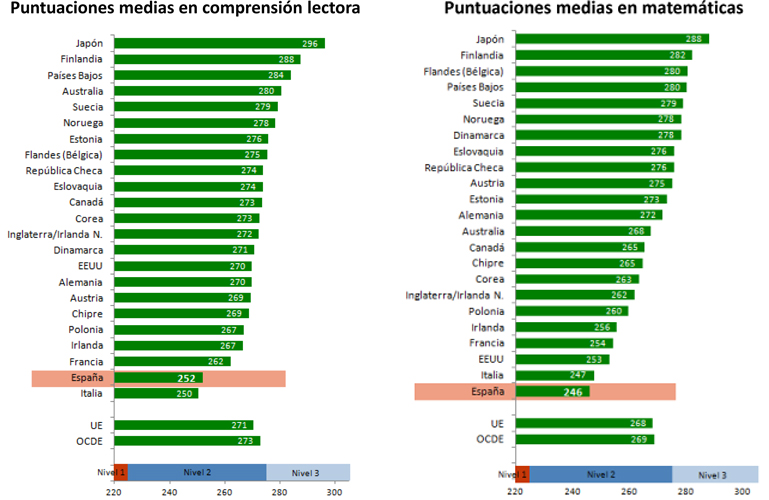
In this period, there was a piece of news that I wanted to comment when it appeared, but I didn't have the time or the inspiration at the time, so now it's rant time. The article can be summarized in these graphics:

The first one shows average results in reading comprehension by country. The second one shows results in mathematics.

Any statistic like this needs to be taken with some scepticism. One never knows the exact details of the tested group, and if everything was fair and really representative. However, we can believe real situation is something close to this.

What this shows is that Spain is full of idiots. Maybe great people, but still idiots. This explains why governments don't know how to solve problems. Even if part of what's happening right now was done on purpose by our government to help their rich friends, there are things that escape to their control, that show they're not smart enough to find a solution. This is paired with a stupid society, and the result is that the stupid society keeps voting for the same idiots all the time.

For a while, I've been thinking that there are two new laws we should use. In each case, I can think of a soft way to apply it, and a hard way.

The first step that we need to improve things in Spain is to demand by law that any person in the government or in parliament has some kind of university studies. If a person doesn't have high-level studies, it means that this person has not shown to have learnt any complex knowledge, ever. If University becomes a privilege for a few selected ones, this could be discussed, but if we manage to keep it public and available to most, this needs to be a requirement.

In the soft way to apply it, any university degree would work. It would at least show your ability to complete more things than compulsory studies, and it would show you're able to learn and understand harder concepts than what a 16-year old knows. One could argue that a degree does not grant you intelligence, or experience, or the best decision-making....but it shows that the person who got the degree has dedicated some effort to it, has learnt something, and that it has been enough to actually pass some subjects and (probably) do a final project. That's how it works in most real-life jobs, at first nobody knows you're good or bad, so the only thing you can give as a reference are your studies. Politicians should be no different.

The hard way would be to actually make some particular degree that is required to be part of the government or to be able to represent people in parliament. The logic, of course, is that having a degree in computer science or art history does not guarantee that you'll be any good at governing a country. The studies itself should include a wide range of things, but economics should be an important part of it. These studies could be considered "second cycle" studies, so you would need first some other degree, and then you could enlist in this course. Again, this does not guarantee a good government, but forces politicians to be smart and put effort into it, not like now where several high members of the main ruling parties and government do not even have studies.

The other step is more controversial, but I believe it's also necessary...basically, I would apply a law that limits the possibility of voting. Basically, with this law, being 18 years old would not give you the right to vote, showing that you're smart enough to vote would give you this right.

Of course this is a very conflicting topic. One could say that being smarter does not indicate that you know what's best for everybody else. There's also the point of identifying what's considered smart. To address how to consider if you're smart enough to vote, again there's two solutions.

The soft way would be to limit voting people to those who have finished successfully the compulsory education. The compulsory education in Spain is at a very low level, but at least it shows you have some degree of studies. Of course this could not be applied for everybody from the start, but a date could be arranged, as in all the people born after a certain year would be required to prove they have finished the compulsory education before they're allowed to vote.

The hard way would be to demand to pass a simple exam before you could vote. This would be done every four years, and it would just require a certain grasp in comprehension and mathematics for example, like in the two graphs I posted at the beginning. I know this system could be abused in different ways, but the current system is also abused, so it's not a big difference actually, the point being that bad governments will abuse whatever system is in place.

Now, before being accused of being anti-democratic, I want to explain my reasons. Basically, I believe that a person should only vote if they're capable of understanding what they're voting for. I'm not saying to force everybody to understand what they're voting for, I'm just saying to prove they could do so.

I really really doubt that a person who cannot comprehend a written text is able to really understand all the implications of an electoral program of a certain party. If someone cannot read, I would be happy to accept their vote as long as they could understand an electoral program read to them. Smarter people may not be able to always know what's best for everybody, and people who may not be as smart should also give their opinion...but as long as their opinion is really their opinion, and as long as they do have an opinion. If huge amounts of Spanish people don't understand anything after reading a text...how the hell are they deciding who to vote? They cannot know if it's good for them or not, because they did not understand it correctly in the first place.

Dumb people are easy to trick and mislead. Dumb people will not understand what are the real intentions of a party, even if they're not lying with their goals. Therefore, I don't see why dumb people should vote. Again, to define who is dumb and who is not, you would only need to prove you're able to read/listen and understand the text, and to do some easy mathematical calculations.

Opinions are great and everybody should have one, but there are things that are facts, and there are cases when something is clearly wrong or clearly right. This is also true in politics, not everything can be defended logically, some facts are true and some are false. Not everybody's opinion should count, if their opinion regarding an established fact has been proven wrong. Emotions are not enough to decide who to vote, they should be accompanied with the ability to reason about it, and then you could do whatever you want. I think I said it before, but you don't ask the village idiot about his opinion regarding your brain surgery. You would only do that if he somehow has proven to have a great amount of knowledge in this topic.....

So why do we let the idiots decide about our life's future, as if it was something minor where all the opinions are good, no matter how stupid?

Wednesday, 28 August 2013

Spanish Joke

Some time ago, I heard a joke that was applied to Spain, but could be used in other countries as well. The joke goes like this:

"When God was creating the world, he divided it in countries. In each country he put different people, and he decided to give two good qualities to the people of each country:

-Germans will be hard-working and efficient, English people will be polite and educated, Italians will be passionate and funny....

The list of countries kept going, until it was the turn of Spain:

-Spanish people will be intelligent, good and they will vote the party from the right.

Of course, the angels around God thought that it was a little bit unfair that Spanish people got 3 qualities, and they mentioned it to God. God answered:

-What you say is true. Therefore, Spanish people will be able to choose any 2 of the 3 qualities that they want.

That is the reason why, in Spain, you will find good people that vote to the right party, but they won't be intelligent. You will also find intelligent people that vote for the right party, but they will not be good. And finally, you will find good and intelligent people, but they won't vote for the right party."

I believe that this joke says something quite true. Of course, it defines things in a very "black and white" manner: How can you assess that somebody is "good"? Some right-minded reporters mention that supporters of the left would like to make right ideals illegal, and this kind of joke may give such an idea.

However, I would say that if you replace "not good" for "selfish", "self-interested" or a similar meaning, this is spot on and perfectly realistic.

In general, what does the right parties support? They have always supported tradition, religion, censorship, discrimination, power and money for the already rich and powerful, ignorance among the lower workers, kings and queens (or CEOs), patriotism, repression, more military and more participation in wars, less rights for the people, less freedom for the people, more work for the lower classes, and less money for the lower classes. In Spain (and other countries) you can add fascism, racism, sexism, dictatorial governments and other things that are usually limited to extreme right parties, but that in Spain is part of the main right party.

It would be simplistic to consider all that "bad", but it's easy to consider it "selfish", as in things that may give you some benefit while others get a worse situation.

And who would vote for these things? Well, there will be lots of low-class people that will vote them for their defence of patriotism, religion, tradition, sexism, racism, military issues and discrimination. For example, lots of lower class people may think that immigrants are taking their jobs, and therefore they vote right parties believing they will put a stop to illegal immigrants. Or they may feel that the other parties are not patriotic enough, or that this party will put women back were she belongs, at home in the kitchen and taking care of kids while men go to the bar and drink and smoke. It could also be something more simple and that it can be considered "good", which is to defend their religious believes.

All this clearly shows a lack of intelligence on the lower class part, since intelligent people will notice right away that there is a larger problem here: The fact that this party will basically screw the lower class as much as possible, which should be the main concern. If you think that a government that defends tradition is more important than being able to eat or to have a house, your priorities are wrong, and therefore it marks you as stupid. Same with religion, you can be a nice person, help the poor, try to support your community and all that, but if you vote a party because they support your religion without considering that the same party will multiply the amount of poor people in the streets and the cases of hunger, you don't have your priorities straight and you don't grasp that this party is not following the original meaning of religion, which usually is to be nice to each other. Again, this means you're basically stupid, sorry if it sounds harsh but it's true. Finally, you could believe the right party's messages that say they will make things better for everybody and vote them. This again shows you're stupid, since the right parties have always defended the same, which is benefits for a very few rich and powerful people while screwing everybody else.

However, there is intelligent people too that may vote for the right party. If you're high class it's evident that this party will protect you and your family, and your interests. If you're middle-high class you can also think that this party may not affect you that much, or that you share some of its ideas an the policies that are more repressive and violent will not affect you. This does not make you a "bad" person per se, but clearly more "selfish": You're supporting the repression, the censorship, the decrease in rights, since you're not really affected by it that much and you can more or less maintain your lifestyle.

Being selfish it's not really bad, you need to be selfish in some degree to achieve a certain happiness. Otherwise you'll always be miserable thinking about the things that you could do for others. However, when such selfishness affects such a big proportion of the population, making their lives so much worse, it cannot be considered good. Specially if you can still be perfectly happy and maintain your lifestyle while paying more taxes or keeping your ideologies at your home.

Of course, if you directly vote them to get a lot more richer and to exploit to the lass drop of blood all your workers and lower class, or to impose your morals by force to people against their will, I will directly consider you to be bad. However, I don't believe that there are that many cases of this in Spain, and it's more like the case I explained of indifferent people that gain something while not losing much or not being impacted much.

That's why this joke is so true: If you are smart enough to have your priorities straight and to understand what each party offers and does, and you care enough about other people that you would like to improve rights and freedom of everybody even if it will not affect you that much, I don't see how you can vote for a right party.

One last comment: Right parties are known for his acts, not for his speeches. If a party defends a huge amount of the things the right parties defend, even with some concessions, that party is from the right, even while claiming to be "centre" or "left".

Therefore, in Spain one needs to be careful, since most big parties are rather "right-ish"....

Thursday, 1 August 2013

Time To Fire People

In lights of my future parenthood, we are trying at home to prepare everything to make our baby legal.

We decided to have a baby in Russia while living there temporarily and being Lithuanian and Spanish. That may cause some problems, as you can imagine, and the past few days we have tried to call our different embassies and consulates to understand what will be needed from us to make the governments understand that the baby is ours, that therefore he has a right to be Spanish and Lithuanian, and to obtain a passport so he can legally be in Russia.

I guess it comes as no surprise to anybody that the result is a clusterfuck of idiocy, papers, lack of logic, incompetence, bureaucracy and so on...

It seems terribly hard to comprehend for authorities of any country that you are actually you. I understand that if it was easy to pretend to be someone, there would be a lot of associated problems to that. I also understand that in the dark ages, the only way to proof that you're "You" would be to bring numerous amount of papers and documentation, together with signatures and even some witnesses.

However, for he past few years, there's this little thing called "electronic ID" or "electronic passport", that we have been using. If you know a little bit about cryptography, you can easily see the point...if you don't, trust me on this: A digital signature can be INCREDIBLY hard to falsify, compared to what can you do using dark photos, good handwriting skills and make up. Specially if the digital signature is authenticating stuff like your actual picture and your digital prints.

Given these facts, all paperwork should only require such a digital signature, the same one that is already used in lots of passports and IDs, like my Spanish ID or my Spanish passport. (I mean, these things are already used regularly, we're not talking about science-fiction stuff you can only find in MIT labs).

Anyway, these facts and my latest interactions with certain personnel has reminded me about a core problem that, I believe, is an important cause of such clusterfucks, and also an important cause of corruption, idiocy, outdated systems and other such things in Spain (and other countries): We need to fire people.

Now, this is a controversial statement. Plenty of times I've indicated that the Spanish problem is otherwise, how easy has it become to fire people. This is also true, so let's specify: We should be able to fire people that are really incompetent or useless on purpose, regardless of position or organization. I hope this clears it more. I can think of 3 groups that would require more firing options.

First, there's public administration workers. Public workers, at least in Spain (maybe in some countries it's different), cannot be fired, ever, except in extreme circumstances (as in, peeing over customers may cause them to be fired. Short of that, it's a rather hard thing to happen).

I know public workers that are great people and good at their job. Just these days I've talked with very competent people. However, I've also talked with really idiotic people, who clearly were bothered by the fact that they had to work now, after a question!.

For some reason, it is very hard to fire public workers, and that's a big problem, because we all need a certain amount of "fear" to perform a good job.

Liberal theories tend to support the idea of companies having lots of freedom when dealing with workers. One of the ideas behind this is that, otherwise, workers are not productive enough and the company will fail. Social theories indicate that company bosses, if given enough freedom, will exploit workers as much as they can, making society a much worse place. Both theories, however, sometimes seem to fail to ignore a more basic principle: We people are, in general, bastards that sacrifice someone's else well-being and freedom if it means we get to have some benefit out of it. It is not true of everybody, but given the chance to do something "bad" that brings a benefit to you, a large amount of us will take the benefit. 

If you apply this principle to bosses, you can see that most of them (not all) will exploit workers if they have the chance. However, applied to the workers, it also says that most workers (not all) will actually be not productive at all if given the chance.

Therefore, we need an equilibrium of worker rights and company rights. This equilibrium would mean that the company cannot exploit workers and fire them at will, while workers need to actually work or be fired.

In the public administration we do not have this equilibrium, and without the fear of being fired some people simply refuse to work. I was told by a public administrator that when someone works normally, not overdoing it but not taking unnecessary constant breaks, lots of other public workers usually complain because it makes them look bad.

It has reached a point where I believe that some people try to enter public administration to avoid work whatsoever. This is unacceptable, and it´s one of the causes of the administration clusterfuck we usually suffer.You may be regular at your job, and then you should not be fired. But when you´re consciously doing nothing most of the time, to the point where yearly evaluations could show how little you are really doing, it should be possible to fire you.

There's lots of possible jobs in the world, and there's always something you can be good enough at to be able to work on that, or something that interests you. Even if you cannot work in something that you´re really passionate about, you can always work at some place and do some regular, good enough, job. The problem is when you´re not even doing that...

The second group that could use more firing is the "kings of the hill". As in Firefly: "Sad little king of a sad little hill". Self-important pricks.

There's lots of people in administration and in different organizations that has some position and believes themselves to be very important. And maybe inside that organization they are important, we're not denying that. However, they act as if everybody everywhere should give them respect just because of that.

A classic example is the typical case of an on-line community, where its creator and moderator, instead of taking a more passive approach or attitude, participates a lot and with hot opinions. Regardless of right or wrong, some of these community creators act as gods, banning people who disagree with them, giving extra benefits to the people who are nice to them, and all that.

Applied to something more serious, the big political parties all work kind of like this. Some public organisations also work like this, and the reason sometimes paperwork takes so long is because these people, by how important they are, need to stamp everything with their signature before it can be approved...while being too busy to do that very often, of course (several of these overlap with the first group).

The end result is that administration and some other organizations are full of very very stupid steps that do not help, do not give anything, and in this day and age can be easily made more secure and easier to perform by technology.

Therefore, we could improve things by firing some of these positions that are rather obsolete, while also getting rid of very annoying behaviours and attitudes that accompany such people plenty of times.

The final group that we need to be able to fire in an easier way are governmental officials and similar high positions. I'd talk about them, but there's no need: To prove why do we need that, we can always check today's circus at the Spanish parliament, the conclusions of which are that the current rulers will deny doing anything wrong ever, and if you voted for them that's too bad, if you want to change any tiny little aspect of their policies you'll need to wait until next elections.

Monday, 8 July 2013

Democracy in Egypt

Last days we've had a hell of a lot of work at the office, and I'm not very aware of what's going on around the world, but I do have read about the fact that in Egypt there was a military coup that removed the president (or prime minister, or whatever was his title) and put another guy in charge, to prepare new elections.

Since the guy who was in charge before was proposing some changes to make Egypt law follow islamist, I believe that lots of people and reporters from the right approved this action. Meanwhile, I've heard some people from the left (not many people were talking about it but I've heard some) saying that the guy had been elected with a democratic vote, and therefore removing him with a military coup is bad for the democracy.

In this case, I find myself agreeing with anyone thinking that this was a good thing. First of all, violence against the people of a country is always bad, and therefore if the army starts killing pacific islamist supporters of the ex-president, that is clearly bad. However, the problem here was that the ex-president tried to made laws that would turn Egypt into another Saudi Arabia, another Yemen....

Basically, I believe that religion and politics should never ever be together. One thing is how a country is governed, and another thing is what you may or may not believe when it come to religion, which I believe can be categorised as "Morals". I think I read some time ago about the difference between "Moral" and "Ethical". I'm still unclear about the differences in some specific cases, but I believe that an ethical behaviour tries to be fair with everybody and tries to give everybody as much freedom as possible without denying freedom to someone else. By difference, a moral behaviour tries to establish a number of things that are considered right and wrong, and then delimitate the freedom of the people based on these categories.

The most clear and easy example would be the topic of marriage. Marriages that go against ethical principles, in my opinion, are done between parts where one of them does not want or cannot have their saying while getting married. For example, the famous argument of marrying dogs would be unethical, because dogs cannot express their opinion on the matter. The same happens with arranged marriages, if families force a marriage, this is unethical. Any other marriage done between two adult people that are consensual and wanted to do so are ethical. Meanwhile, if we use moral to decide what is a correct marriage, we may get to the conclusion that the only possible marriage is between a man and a woman, or that forcing a daughter to marry a man is morally correct.

I am of the opinion that all laws should try to be as ethical as possible. Governments actions should also be as ethical as possible. And I believe that people, as a whole, should not have anything to say about it. Let me clarify that....

In Egypt, the guy who got elected wanted to use the Islamic law as the basis of the laws. Islamic law, as any religious-based law, uses morals. Some things are moral, some things are immoral, and the immoral ones are legally punished. I believe this is wrong. However, you may say that it was something democratically chosen by the people, right? Well, first thing here is that, even with lots of supporters, I believe that the percentage of people that voted for this guy was around 25%. It may be more than any other option, but this still leaves 75% out.

But even ignoring that....by applying a moral code of laws, you're forcing your morals into lots of people that may not share them and may not agree with them. Even if a huge majority, 90% wanted this, there's that 10% of people who basically were forced to "convert" to these unshared morals. Therefore, I believe this is clearly wrong and should not be done. Instead, if you make ethical laws, everybody keeps their morals. Then, if 90% of the people have certain morals, they can still apply these morals with themselves, and avoid immoral things. They're free to do so, while leaving the people with different morals free to act differently. Ethics gives you freedom, even the freedom to have the morals you want.

Therefore, whatever the votes, whatever the support, the guy who got elected was doing something wrong in my opinion. Sometimes it may be hard to differentiate between something ethical and something moral, but basing all your laws on religion is quite clear a moral thing. Religion is not the only thing that can add morals to laws, though, and one needs to be always careful and try to stay on ethical grounds when making rules for everybody.

I would add a comment about democracy. Democracy is not voting every 4-5 years and letting the elected government do as they please. Democracy is not governing for your supporters only. Democracy is not denying rights, even when a majority of people actually wants to deny those rights. True democracy is to let everybody have a voice, an opinion. And true democracy is deciding all together what to do next, hearing at least every side of an opinion, and letting each side influence the outcome, while at the same time never imposing subjective things even when a majority would like to do so. I don't believe it is democratic to, for example, ban dancing, even if a majority of people agrees. If the action is not limiting another's person freedom (basically, not hurting anyone), even a  majority of people should have nothing to say about it.

When this does not happen, it doesn't matter how it is done, but the government needs to be kicked out (and kicked hard).

And kicking out the government is always going to be a good action in this case.

Friday, 3 May 2013

Logical fallacies and religions

Today i read a post in facebook that made me angry. I will proceed to copy the text here, so you know what i'm talking about:

"True story.

An atheist was seated next to a little girl on an airplane and he turned to her and said, "Do you want to talk? Flights go quicker if you strike up a conversation with your fellow passenger."

The little girl, who had just started to read her book, replied to the total stranger, "What would you want to talk about?"

"Oh, I don't know," said the atheist. "How about why there is no God, or no Heaven or Hell, or no life after death?" as he smiled smugly.

"Okay," she said. "Those could be interesting topics but let me ask you a question first. A horse, a cow, and a deer all eat the same stuff - grass. Yet a deer excretes little pellets, while a cow turns out a flat patty, but a horse produces clumps. Why do you suppose that is?"

The atheist, visibly surprised by the little girl's intelligence, thinks about it and says, "Hmmm, I have no idea." To which the little girl replies, "Do you really feel qualified to discuss God, Heaven and Hell, or life after death, when you don't know shit?"

And then she went back to reading her book."

That's the text. You may consider it a harmless joke, but I find it very annoying.

It reminds me of another text that went around some time ago, where there was an atheist teacher and a student discussing spiritual things, where the student made the teacher sound foolish. At the end, the text claimed this was also a true story, and that the student was Albert Einstein.

Where to begin? I'll start with the logic side.

When argumenting things, you need to use logic if you want to make a good point. I will say that sometimes arguments have convinced people without using logic, but thats because we people are all idiots and easy to manipulate. Lets ignore the idiot factor and agree that you would need logic.

When trying to argument something, you would need then to use arguments that make sense. Eventually, you may realize that in a discussion, there is a core principle, from which all logical arguments are created, that is different in each side of the discussion. With good arguments, you can agree to disagree on the core principle, or correct the other's logical process, in which the core principle is the same but one of the steps was logically incorrect.

Anyway, that's usually too much trouble, so the solution is to center your attention to we the idiotic people. To do so, you can use logical fallacies, things that seem like arguments, but aren't.

The post I copied here uses a very nice logical fallacy, the "strawman". The strawman fallacy consists on creating a character that defends the position contrary to yours. Optionally, you can add other characters with your position. Once you have this, you make this character explain the opposing argument, or defend it in some way.

Once you have done so, you can argue against that argument. Since you control the strawman, you can make him unable to respond, or answer foolishly. If this was a real person, the outcome would probably be different. With the strawman, you can shamefully make them unable to respond.

As an example, let's imagine the same story, with two differences: the man smugly(another trick, to show he's stupid) asks to talk about the one true god that we all should follow and about heaven and hell(let's say christian god). The girl answers in the same way. The man shouts "shut up, heretic!" and detonates a bomb he had strapped on him, blowing up the plane.

You see? All religius people are ignorant (they dont know about shit), smug and condescending (trying to teach a little girl), and violent fanatics (shouting angrily and resorting to bombs). It's very essy to "prove", because they're my characters and I can make them do whatever I want.

Of course, the story I just explained sounds stupid. That was its point. This techniche is widely used by lots of sides in different types of arguments. It provides examples of other point of views wihtout letting them defend themselves or while making them stupid, thus making the wanted point more reasonable to the reader, or listener.

The story with the student used the same fallacy, plus the appeal to authority. This one is also widely used. In the student story, it was claimed that Albert Einstein was that student. This is not even true, but it's irrelevant in this case. Let's cringe in horror and say he did say these things. So what? Albert Einstein was a great physicist, so I would listen to his opinion in physics. I would not care about his opinion in cooking, because he's not remembered as a cook. He is an authority, but an authority in some topic. Appeal to authority tries to prove something by simply saying someone important said it. The missing detail is to say that whoever said it has to be a respected expert on that topic for it to be considered useful. And even so, it's not enough if there's no solid proof behind the comment. I believe it was Aristoteles the one who thought that arrows without a pointy end would move faster. He was a great thinker, and he was very wrong in this.

Summing it up, to properly use an authority they have to be experts in the discussed field and have undisproved research defending that theory. Otherwise its as useful as proudly declaring your 3-year old son agrees with your idea and thinks you're awesome(good for you, but irrelevant in a discussion).

Since we're talking about religion and logic, I'd like to add a few comments about religion itself. As explained in Dogma, I'm fine with people having beliefs, or ideas. I'm less fine with organising such beliefs in a strict ruleset that needs to be obeyed and shared, accompanied by a big organisation with military-like structure to help its diffussion and power-gathering.

Anyway, it's ok to have beliefs, just be smart about them. Don't use fallacies, and use your brain. I'm more familiar with christianism, so I'll use it as an example:

1- Your sacred book is a list of guidelines, of moral and ethical stories, written by several people among the years and, sometimes, edited by people in power who had their own agendas. Don't take it literal, and don't take it as proof of something. Your book was not done when cars existed, and therefore it does not reflect some of the heavy changes society has gone through. Your book was not written by God, it was written by people, and usually religions agree on the fact that people make mistakes. Focus your attention to the morals, not the content. For example, Christ was trying to spread the message of loving each other, and not doing stuff to people that you would not do to yourself, and otherwise. He was also warning about greed, and about the corruption of money and power. Use logic to apply this message, if you want, and try to fit it in your life. You may realize that organized religions may have twisted some of the ideas for their own purposes, in the process...

2- As mentioned, your sacred book is a number of moral tales. Don't assume they happened for real, and concentrate on the meaning. Science will prove again and again that some of the stories do not fit in our world. It will not be an opinion, it will be proof. For example, evolution is not an opinion, it's a fact. To say otherwise is stupid. To let this shatter your believes, right now, is stupid as well (when it was discovered it was more normal that it impacted beliefs). If you really have beliefs, accept that you may not know how "God" created the world, or in which ways it was made to work, and think that science is just discovering these facts. There are lots of things still unclear, more than before, i'd say. If something as simple as evolution makes you doubt, your beliefs were not that strong on the first place...

3- Be tolerant. I don't know about all religions, but in general I believe that the idea behind most of them is to be nice to each other. If someone's actions are not insulting you directly or damaging someone, let them be. I believe most religions say that people not following them will be judged by God and be punished if they deserve it. Therefore, don't presume to know God's will, and let people do whatever they want. If you belief they're wrong, they will be judged anyway, right? If you're trying to "save" them, well, i'd say you may want to try, but you should know when this intromissions are not welcomed, and avoid them. Specially, avoid any intromissions that would start with you being angry. Remember the free will part, everyone should be able to apply it, don't reduce it in others. If someone is sinning in your eyes, that's their problem, not yours.

4- Religions are not (usually) being attacked by non-religious people. As mentioned, discovering how the world works and realising that your sacred books and ideas mention something different should not be considered an attack. People may react badly against religion when religion is telling them what to think and not allowing any flexibility whatsoever. Always remember the catholic church(even if you're not catholic) during the time of Galileo. The church did not like to have proof that earth was not the center of the universe, and denied it and attacked people who defended this idea. Whatever religion or believe you may follow, think if you're doing exactly the same, and try not to. Just use your brain, and adapt the core principles to this new data. What is more important, if humans evolved or not, or if humans should do good or not?

5- If you believe in the fact that there is a perfect being, and that we humans are far from perfect, accept that this can perfectly apply to you and all the people who created and/or are currently part of your religion. Question things if the messages and the actions do not fit, and always use your brain.

Some time ago I read a brutal sentence that sums up the point i'm trying to make. The sentence said more or less the following thing: "Religions are like dicks. You can have one and feel proud of having one, but it's wrong to try to put it in other people without their permission".