Showing posts with label Books. Show all posts

Tuesday, 27 October 2015

The Last Discworld Novels

So I finished the Shepherd's Crown, and a lot has become clear.

The novel itself....could be better. Much better. Actually, it is similar to the last novels he wrote, and it is painfully sub-par compared with most of other Discworld.

I think his last novels that I read were Making Money (probably the less affected), I Shall Wear Midnight, Unseen Academicals, Snuff, Dodger, Raising Steam and The Shepherd's Crown. And all of them have several of these problems, although the worst offenders were the latest.

It would be a disservice to Terry Pratchett to say that his last novels were really good. They were not. The characters became Mary Sues, perfect, clearly without any problems to survive the story, with everybody agreeing with them or fighting them in a very peculiar way that made them even more correct and successful. And characters were not speaking any more, they were giving monologues,  they were offering speeches. Worst of all, in the last book all of a sudden magic could do everything and all witches had powers never before mentioned. There were even continuity errors with previous books. And it ended with a battle, a battle without soul, without casualties (well, one, but I would not count it), without doubts about who would win.

It saddens me to say so, but Terry's novels died before he did. And well, what would one expect? He had Alzheimer's disease, which made writing hard, and a very limited timetable (his life expectancy after the diagnostic was extremely short). He wanted to write some stories still, but the end result was that he "rushed" his last novels, I guess in fear of not finishing them. This is the hard truth, what my First Sight is telling me.

In the last pages of the book they explained that in 2007 he was diagnosed, after finishing Nation. It is the year when Making Money was published, and you can see that all the books written after this moment decrease in quality. Apart of what I've said, they cram social issues in there in a way that doesn't work, because it is not subtle or woven with the rest of the plot. I'm not saying you cannot explicitly defend social issues in a story, just that you need to know how to fit them inside, and the last books did not manage to do that very well.

The thing is, remembering Terry Pratchett by these books is also a disservice, a huge one. If you want to know Terry Pratchett and why he was one of the greatest writers that have existed, you need to read all his other books.

You can start with Nation, one of the last he wrote, a book that grips your emotions and manages to express sorrows, fears, determination, brutality, love and plenty of other things in its characters and in you. A book that questions who's the uncivilized, the savage, the one without important culture. A book about science and discovery, about survival, about growing up.

You can continue with his early works, Johny Maxwell, the Bromeliad Trilogy, Strata, etc. They may be minor, or smaller in scope, but they teach you about humanity, about youth, about beliefs and traditions.

You can see the genius of Good Omens, genius shared with Neil Gaiman, a book about the apocalypse that laughs at religion while defending belief, spiritual and in humanity, and in our inner goodness.

And you can tackle Discworld. Discworld is huge. The first books are small jokes, good but without a point. But the rest is simply awesome. You can analyze traditions in Pyramids. You can consider revolutions in Nightwatch. You can understand life and death in the Reaper Man. You can see the problem with blind belief in Small Gods. You can enjoy the primordial energy of Rock in Soul Music. You can understand stories and the evils of Christmas in Hogfather. You can see what a good teacher is while pondering about the nature of time in Thief of Time. You can talk about integration in Men at Arms. You can see racial problems and stereotypes in Thud! or Jingo. You can experience that, and a thousand times more, if you immerse yourself in his books. You can experience poetry that leaves marks in your soul, and right afterwards  enjoy a vulgar joke that makes you laugh without control while in the subway. You can ponder deep philosophy while being entertained. You can see that wars are not meant to be fought, and that true heroes do not fight but prevent the fight from happening. You can learn that good people, if they think you should die, won't waste time gloating and will kill you straight. You can see that being human is a state of mind and a matter of choice.YOU CAN HAVE FUN WITH DEATH. You can experience a different world that is exactly like our own.

Terry Pratchett has all this to offer, and I'm not going to insult his memory by saying his last rushed books done while terribly ill are good. I will say that the books before that moment are beyond good. They are amazing. They are incredible. They are mind-blowing. They are hilarious. They are dead-serious. They are totally worth your time, and you should read them. All of them. Even the last ones. And then reread them.

That's how we do proper service to his memory.

Monday, 25 November 2013

World-Building and Bioshock

Apart from taking care of our baby, working and a lightning trip to Moscow and Barcelona, I've been trying to play Bioshock Infinite lately.

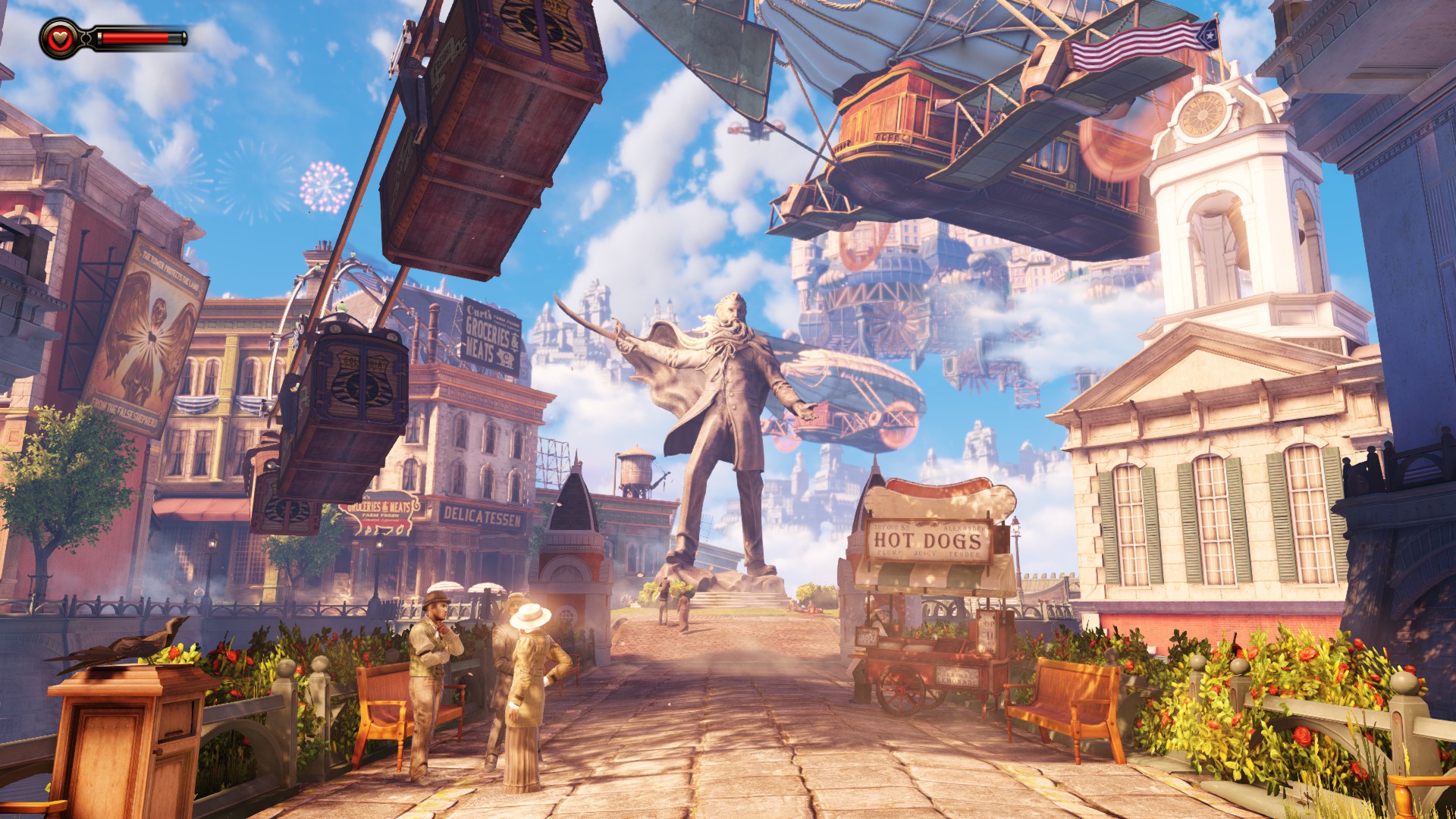
I heard and read reviews about this game, and there has been lots of posts, screenshots and gifs around the internet. Just form the beginning, the game can catch your eye by looking like this:


It's not only graphics, which are really good...is the world that they're showing you. A world of fantasy, a floating city with rails connecting sections, huge statues, a thriving population, shops, houses...all this mixed with steampunk technology. It looks awesome.

However, this is not all, by far. I started playing and was immersed in a complex and weird story, starting with an introduction that takes a long while before you even fire a single shot (apart from firing in little fair tents that have games of marksmanship). This introduction is incredible, makes you feel inside this place...but more important, makes you believe such a place exists.

Maybe a great part of what makes art amazing is its ability to create worlds that do not exist. You can see that in movies, in literature, in dance, even in music and paintings...they can show reality, but they can go further than that, and show you the realms of the imagination. These realms can be amazing, scary, dark, cheerful, modern, dream-like, happy...and in these realms you can make your own rules, in history, in economics, or even in physics.

Games are art, even if not recognized by everybody, and good games create such worlds while putting you in control of someone or something inside that world.

When these worlds are created with art, it is very important that they're created well. A bad painting, that messes up proportions just because of lack of skill will remind you that it's just a painting.  You may enjoy it, but reality will point out the problems it has, and you will return to your own world much faster. You can apply that with any other world-building work.

That's why world-building is very important. The most clear example you can find are novels. Novels, by its extension, have lots of time to create a world. It's hard to put a lot of details in a movie that last 90 minutes, but in a book of 500 pages you have time to develop a universe inside. Books have a lot more margin to define this world, which can be slightly or a lot different than our own.

And nothing will make a story lose its appeal as a badly-build world. I believe Terry Pratchett (or somebody commenting on his work) once mentioned that his created city of Ankh-Morpork submerges you in it because you don't need the protagonists to be there for it to work. If the hero was not walking around, doing hero stuff, its inhabitants would still work, and live, and eat food, and buy things, and all that. That created world is so rich that when the heroes stroll around it, it's easy to believe you're there with them. It makes sense internally. Does it matter that magic is real, the earth is flat, and that the sun orbits earth in there? No, because its consistent with itself, and it works...if you imagine a world described as it is in the books, you can see that it's solid, it has its own life.

Now, that may sound blasphemous...but let's have a look at Tolkien. Let's concentrate on Gondor. What does exactly that region do? It basically fights the Dark Lord, permanently, always at war for who knows how many years, all their people soldiers, all their people closed inside their walls. Now, Tolkien has great world-building skills, and this world is rich and varied. However, Gondor in particular makes little sense, and personally that's why it seems also like the most boring part of the books, when Gondor defends itself or attacks (when Rohan helps it's fun, but while there's only Gondor, it's boring), because I cannot help but wonder how the hell it's still standing, or how people manage to live there.

Now, you can maybe say that Tolkien explained these details in some other work, or that some things are implied without being said...however, I still think that Gondor, in the Lord of The Rings, is not well made, and it fails to stand on its own logic. People would not live there if it wasn't for the plot.

There are lots of lesser books that nevertheless grasped quite well this concept of World Building. For example, the Belgariad and the Malloreon are not greatly written, or very original...but its characters are much more alive than some of Tolkien's characters, and there's a lot of details to simple facts...like the fact that, if somebody's going to wage war, that someone is going to provide food for the troops, and then if you invest in some cheap food, you may get huge rewards...or, that a moving war front needs a constant supply of materials, which needs to follow you and form a chain with the origin of the supply. That gives a lot of coherence to the book.

Before I mentioned that movies do not have as much time for world-building...but that does not mean they should not have a good one. The easiest way to see that a movie is full of bullshit is if the world is rather inconsistent with itself. Take Star Wars prequels, where in a galaxy of millions of planets, that have billions of people and species in each planet, there's like 6 characters that are always present when something important occurs, no matter the place. That's laziness right there, and returns you to reality fast enough to scream bullshit.

Games are in a middle term, taking longer than movies but not being able to say as much as books do. In games, immersion is very dependant on that world-building. The first Bioshock game was impressive, the water rendering was amazing, physics involved in its movement were pretty awesome, and the introduction was very surprising...however, the supposed "city" did not seem a city at all. Even considering that an underworld city needs to have small corridors, it never felt like corridors, just a single endless corridor that railroaded you from place to place, with a few exceptions where you had a couple of different rooms to visit. Also, everybody was an enemy. For a city that was supposed full of people, even after a disaster, it felt empty, lifeless....and the fact that the corridors were not a labyrinth, or a grid, removed the feeling of being in a city, putting you back in reality and saying "Game with linear design".

Bioshock Infinite, in just the first hour of gameplay, shames the first Bioshock by showing how it's done: It moves you to a great city in the sky, with people, with attractions, shows, shops, toys, children and adults, subculture, rebellion, social problems, radio shows, music.....in general, life. You can see that people live there, you believe so, because it makes perfect sense, internally. The game still has a linear design, but by defending these flaws as part of life in there, such as the fact that private houses are closed, or that flying streets sometimes are not connected and may have timetables or change depending on the moment, makes you ignore the fact that you're basically moving from point A to point B in a straight line.

You feel in a city, with people living there, and you see that it does not require your character for it to make sense.

This is world-building when done well. Great stories and great art will always have great world-building. And Bioshock Infinite does it very well indeed....

Friday, 22 February 2013

The Dresden Files and other sagas

I don't remember if I mentioned before that I also love to read.

We both have kindles at home, and we both like to read whenever we can. I've always liked to read, and since we have kindles it's really easy to gather some books in the same device and just read one after the other.

I've been reading since I was very young, and I've managed to get certain...speed. Depending on how motivated I am and how much free time I have, right now a book 300 pages long may take me 3-5 days. If I'm very motivated to read, that may take just some hours and be done in less than a day, and if I'm not specially motivated it can be prolonged for a couple of weeks or so.

The problem with that is that books I find very interesting don't last me much time, and I always feel...I wouldn't say depressed, but demotivated to do anything else, after finishing a good story. I just want more of that story, and since I can't get more, I don't feel like reading anything else. Sometimes I feel like not doing anything else at all, in fact.

The solution to this is a good saga. A good series of books that you can read one after the other, sometimes without sharing a common plot but connected between them.

Discovering good sagas is an awesome feeling. It's not always the same case, but usually you start with some little book, that usually is good but maybe not spectacular. They usually have beginner's mistakes, and even when the story is compelling, they may have some boring parts, or some sections that do not make much sense.

Then you discover that there are more books, and since the first one was interesting, you start reading those. The author gets a better pace, the stories become more complex, there are less mistakes and things become more and more interconnected. The characters develop, and you start liking them more and more. You share their hobbies and passions, their fears, their lives. And you get into their world. You want to know more about their world, and you devour every little new piece of information, recreating everything in your mind and joining all the pieces into an awesome experience.

Of course, exiting this world is traumatic.

For this post, let's just focus on 2 sagas I want to comment about.

The first one is "Song of Ice and Fire" (stupidly known as "Game Of Thrones", because TV viewers are morons according to TV executives). It's a  famous one, and lots of people love it. I had re-read it again once the 5th book came out, in order to remember all the details and get back into that world.

The merit of this saga is to twist preconceptions and play with common fantasy tricks. The promised hero has a high chance of being killed two lines after appearing in these books. Not saying that this happens, I'm just using it as an example. The first two books can be summarized as "things go to hell, the bad guys get huge rewards for being bastards", so they're kind of depressing and slow, even if well-written. The third book is awesome, and I believe is the main reason this saga has so many fans. Things do not get better, but you see that, well, there is some remote hope at least...sure, the author likes to crush hopes, but there's always a little left, somewhere.

There's one thing that I don't like about these books, and is the fact that they were not planned very well (as the 7 year break can prove). The author is making things more complex and not offering any kind of resolution anywhere. He's not solving threads, he's creating more. I've seen this happening before, in other stories. The end result is usually not pretty, with years passing between updates and huge plans about the story that are never applied. I really hope to be able to see the end of it, but I'm not sure the author will be able to pull it off, even if he's a really good writer...since, by his own declarations, he has gotten stuck more than once in some parts that did not advance the story.

Maybe that's his ultimate preconception twist: All these threads left loose, with an ending where everybody dies and nothing gets resolved. Maybe the books are a huge staged suicide preparation by the author, where all the rabid fans will enter like a swarm to cut him into pieces after reading the end...With this author, who knows?

The other saga that I want to talk about is "The Dresden Files". And it's awesome. A friend, Joan Serrat, recommended it, and it's true, it's just awesome.

The books follow the stories of Harry Dresden, a wizard and private detective, in our modern world. Everything is narrated in first person, in the past, as if it's some kind of diary written by the protagonist. The thing is, in this world all the myths seem to be true. There are faeries, vampires, zombies, werewolves, ghosts, Norse gods, angels, fallen angels, paladins, demons, God, other Gods, Eldrich Abominations, Outsiders....and as usual, most people have no idea, since these beings are hiding in plain sight, living in our world and conspiring against each other.

These books can also be described with "Things getting worse all the time", but the experience is much different. First, things get worse, sure, but they tend to get a little better at the end of each book (although not in all of them). Second, the characters are usually pretty awesome. The books are filled with pokes, with action, with crazy ideas that work. They mix magic and practicality (why fight a dark wizard with magic? Just shoot them in the head when they're distracted, or get close to them and punch them to unconsciousness), and there's lots of comedy thrown in the mix (although there's also plenty of dramatic moments)

The first 2 books were a little bit...formulaic. However, I read that the author did that on purpose, to demonstrate that formulaic books do not work. And he was completely wrong, and they were very successful. Since then the other books had more work and care in them, and they got better and better. I got quite addicted to them. They also play with some preconceptions, although more like in the way the characters are thinly aware of being led as if in a story. For example, after several incidences, the main characters know better than to say out loud "things cannot get worse than this", since the universe is happy to prove them wrong...

There's lot's of pop culture references, geeky stuff, bad jokes, and plenty of irony and sarcasm, mixed together with apocalyptic fights, conspiracies, murder investigations, soap-opera plot twists, femme fatales taken straight from black novels and lots and lots of action, in an awesome way (I don't want to spoil some of the awesome things that happen in the story within this post, in case someone decides to read them).

In a way it reminds me a little of Firefly, with the right mixture of comedy, tragedy and action, and a special touch and care that makes it quite compelling. (By the way, there's a Firefly reference in the last book...which the main character does not get, which makes him grumpy for not knowing about it).

So far, there's 14 books plus one extra book that collects short stories the author wrote about this universe. In theory I believe the author plans to make around twice as many, probably ending up with close to 30 books, and ending the whole thing with an apocalyptic trilogy.

The bad thing is that the last book came out last November  I started to read these books at the end of October, and I finished them in January. The author seems to be able to write a new book after a year/year and a half, but that still means that a year or so will pass before we get a new book in this saga, and we're far from the end of it....when I finished that last book, I got the familiar feeling of a lack of will to do anything for the next few days....

I know I'm repeating myself, but this saga is just that awesome. Read it. I'm really tempted to re-read it myself, after I finish with my other current books....