Wednesday, 21 May 2014

Economics, Apartments And MMORPGs

As I mentioned in previous posts, we're currently searching for an apartment to buy. If we don't find anything before we go to Rio it's fine, but we're investigating to see what's in the market, and if there's an affordable apartment that we like, we will not wait 2 years to get it. Right now we've found one that we may like, and we've even made an offer, but things are still pretty much in the air.

As I said, the whole selection process deserves another post, but right now I'd like to talk about apartment prices, their negotiations, and economics in general. And also how the experience of playing in a Massive Multiplayer Online game helps a lot as an Economics case study, for apartments and for the world in general.

Apartment prices in Spain are still stupidly high compared to people's salaries, but right now they're reaching a level where you can consider to buy one without sacrificing your first-born to the bank. Second hand apartments are still the only option because, with a few exceptions, new apartments are owned by banks. Bank managers (as in bank owners and directors, not office workers nor office directors) know that the prices have gone down and nobody is even able to consider paying such prices for new apartments, but if they lower the prices of new apartments they need to write down that they lost money. Of course, they'd prefer to rape their mothers before admitting that they screw up big time and that they have thousands of useless empty houses that give no benefit, so instead they don't lower the prices and maintain a price bubble.

They hope that the prices will go up again and they will get a benefit. This may happen, but it may take 50-100 years (which is how many years may be needed to get back to a situation in Spain where most people not only can easily buy houses, but can also eat afterwards). Meanwhile, our friendly Spanish government gives them our money (recovered from us through taxes) so they can continue operating without having to get money from selling that big amount of useless cheap houses.

So, we're left with the second-hand house market.

In there, things are currently interesting. Prices were not able to resist the evident difference between supply and demand, and they have plummeted quite a lot. Just 7 years ago it was normal to pay 500.000 euros for a small hole in a wall, and now it is reasonable to get decent places for 200.000 or less (depends on size of apartment, situation, age, state, etc.).

Now we're in the process of negotiating the price for an apartment we consider as an option.

Negotiating prices, reading the market tendencies and the economy in general reminds me a lot about the time I was playing Lineage 2. Lineage 2 is a Massive Multiplayer Online Role-Playing Game (or MMORPG for short, pronounced like yhatzee does). You have a permanent world where you log in and your character appears. Levelling up and progressing through Lineage 2 is an extremely hard task (or it was when I was playing) that it's not easy achievable. (all the following comments are based on my experiences of the game when I was playing it, before 2008).

The problem I faced when I was playing Lineage 2, is that to level up you need to invest a lot of money in resources and equipment. And the process of levelling up does not reward you with equivalent money. Basically, to level up you need to lose big amounts of in-game money. To be fair, there are ways to get money levelling up and hunting monsters, but they require you to play for 8 hours straight, together with more people, and to limit usage of resources to a minimum. Even like this, profits are minimal. In this world it is true that permanent growth is possible, since when you kill a monster more money gets added to the world. Anyway, this creates funny economic dynamics.

To put it in perspective...once you reach level 20, the equipment that you will need to start using at that moment to be able to fight people and monsters of your level costs close to 2 millions in the internal currency. Once you get to level 20, if killing monsters has reported you around 100.000 of the internal currency count yourself as lucky.

As you can see, there is a bit of a gap between standard income and necessary money to survive. This only gets worse in later levels, since after level 40 the equipment you need is not even sold in game shops, you need to craft it from pieces that monsters drop. Getting all required pieces takes usually more time than levelling up to the point where the equipment you were trying to create is now useless to you.

As a result of all of this, the basis of living in that world is player commerce. Players have the option to trade things and even open shops that offer things and services (like crafting services). Capitalism is king, and prices evolve with the time depending on demand and on what is affordable by most players. What's more, thanks to the constant influx of money to the economy from the players, the world is in a permanent state of inflation, with very strange and particular cases of devaluation. The ones that got rich keep getting richer, and new players will have it very hard to reach a stable economic situation where you don't need to save every single coin.

This really teaches you the workings of the real world, if you want to survive inside the game. For example inside the game I managed to establish a small business of selling helmets. These helmets were needed to complete a set that gave some extra stats for players between level 40 and 52.

However, I did not own any helmets. I did not have the pieces and materials that allowed you to build such helmets. I did definitely not have the ability to even finish building these helmets.

What I was doing was buying materials in a city, for a price that I knew was rather cheap. I bought them in bulk, and when I had my calculated quotas of materials then I proceeded to contract players who had shops to create composite materials. Finally, I contracted someone who was able to made the actual helmet from the composite materials and pieces.

Once I had the helmet (or helmets), I proceeded to go to another city where this helmet had the biggest price (because prices changed from city to city, given the fact that reaching each city required different levels and hours of play). In there I opened a shop and sold the helmet.

Recollecting and buying all the composite materials and pieces, and then contracting other players to build composites and the final helmet was a long process, and it costed around 1.2 millions in the game currency.

However, the completed helmets were sold for prices between 2 and 3.5 millions (depending on the moment). In the worst case, I got 166% of the invested money back. In the best case, 290%. And I did absolutely nothing. I was just an intermediate that knew prices of materials and prices of the finished item, and knew which margins were acceptable. Sure, I wasted a lot of in-game time on this, but it was usually time I was studying at university, and meanwhile my computer was on with the automatic shop activated so other players could sell me materials or buy my helmets.

Sometimes I got people competing, trying to sell helmets next to me for 1.5 million and similar things.I just bought all their helmets with my investment money and sold them for 2.5, getting me an easy, fast and clean benefit of 1 million per helmet.

So, this game showed quite easily a number of points that you always need to consider in doing businesses and buying things, especially when their prices do not match the price of materials used or hours invested in them:

1-Living is expensive, and working hard does not guarantee that you will have money or that you'll be able to afford necessary things.

2-In order to win lots of money, you need to start with lots of money.

3-Without laws regulating business, established companies can ruin any competitors by just buying their stock to resell it at inflated prices or by selling at a loss until the competitors run out of business.

4-Try to avoid as many distributors, agents and other intermediaries between the maker of the product and you. Each step makes the final product stupidly more expensive than the real cost of making it.

5-Monopolies will abuse their position of power and inflate prices.

6-Even with inflated prices and monopolies, customers will call bullshit when the price is too much, and they will opt to live without your product if necessary.

There are more lessons that you can take from the game, but there's no need to list all of them. It's just to show that these games are great examples of pure capitalism (and how incredibly crappy it is for everyone that doesn't have a great idea or control over some particular market). It also shows the catastrophes that can happen in such unregulated markets. (there's a lot of other MMO games that can show you examples of this).

Regarding apartments, what the game taught me is that the price of such things is as much as people are willing to pay. Building an apartment does not cost their actual prices. The apartment prices depend on the idea of a fair price that most people will have in their minds, and prices will change only when people think they should change.

At the moment, every week or two I get notifications that some apartment I was interested dropped 10.000 euros, or even 20.000.

I believe that no matter what newspapers and government are trying to advertise, people still can't pay for apartments, and what's more, people still believe they should not pay for such prices and that prices will go down. There's a big advertising campaign to change people's minds, but I don't believe it's working yet.

I want an apartment where we can live, and I don't care if the prices will drop more, or will increase later. I just want our own place. However, it is an interesting moment to buy, and it is funny to see all the people trying to convince you prices might rise a lot any time next week...

Maybe I'm wrong and prices will really increase soon....but somehow I doubt it.

Monday, 12 May 2014

Double Fine And Broken Age

A few weeks ago I was finally able to play Broken Age for a little bit, and I thought I wanted to explain the story, since we're rather proud to have participated in it :)

For those of you who do not know, Double Fine is a games development company created by Tim Schafer. Tim was one of the people working in LucasArts when they developed some of the greatest graphic adventures ever created, and he did or participated in most of them. However, one of the last games, Grim Fandango, didn't do good in sales. This, accompanied by other great graphic adventures that failed to produce money, caused big studios to abandon this format of gaming. 

After Grim Fandango, Tim went to create Double Fine, and they produced a number of games. Their first one was Psychonauts, another great game (this time a platformer) that did not do so well on sales at the beginning and did not help the company in stabilizing its situation. 

The next game they developed was Brütal Legend. However, during its development, their publisher (Activision) decided that they wanted a different game, and when the studio declined to change it, Activision dropped them. The studio managed to make an agreement with EA to publish the game instead, but then Activision filled a lawsuit claiming that they had invested in the game and were still interested. Things eventually got resolved, but the studio suffered from it, and the game didn't have all the content it originally should have, and became quite shorter. It still is a pretty good game. The gameplay is a little bit lacking, but the story, cast and atmosphere are really awesome. 

After this incident, Double Fine was in a precarious situation, lacking money and low on morale. They managed to stay afloat by releasing some smaller games produced with the same engine used in Brütal Legend. In this situation,  they remembered that fans constantly were asking them to do one graphic adventure like the ones in the past. Big companies said that this was no longer profitable, and therefore no one wanted to invest on them...but with the internet, there were alternative ways of financing such a project.

Kickstarter is a website that lets you donate money to projects you believe are worth doing and that lack funding. At the time when Double Fine was considering its future, Kickstarter had done some small campaigns, with only one or two very successful ones.

Double Fine decided to make their fans prove what they were saying and proposed to fund a new graphic adventure, using this video to promote the bid. The initial bid was 400.000 dollars, which is quite a big sum, of course...

For some weird reason, I managed to find out about this the same day that they put this video up. I got really excited about this, and I went to check the Kickstarter page. I wanted to donate money so a small, great game company could basically do whatever they wanted with no publishers messing around the final product.

When I entered the page, donations had reached 800.000 dollars. The 400.000-mark had been crushed in less than 8 hours. The Kickstarter server was crashing and didn't handle the load well. In the middle of this, I managed to make a small donation. I explained the story to Olia, and she got excited about it as well, and we started to check the page and refresh to see what was happening. In a few minutes thousands of dollars were being donated to the project. Everybody was crazy about it, the comments of the people participating were awesome, and checking twitter accounts of people from Double Fine and Tim Schafer, they couldn't believe it either.

We actually saw it arrive to 1.000.000 dollars. It was amazing, and less than 24 hours had passed. It felt like  a special moment of partying with the world.

After this, the rhythm of donations slowed down, and days passed without big donations. However, in the month that the campaign lasted, they managed to get 3.3 Millions.

I forgot about this for a long time, and after I while I read that even with that money they had production problems, because they made the game way too big. In the end they divided the game in two, and decided to sell the first part and then produce the second part (that would not require another purchase).

The game came out just recently, and since I was a backer, I had the right to get a copy. I didn't install it in a long while, but some weeks ago we finally tried the game that we helped a little bit to make.

We haven't played much, for obvious reasons....but we can already tell: Broken Age is awesome. The animation, the drawings, the voice acting, the music,  the little details...it's incredible, it feels like playing inside of a painting.

What remains to be seen is if the plot and the puzzles are also top notch since we haven't played much....but so far the feelings we're getting are pretty good.

The most important thing about all that is that it has shown that publishers can be very, very wrong about their opinions. Sure, publishers know a number of tricks that increases your chances of being economically successful, and they may correctly guess that some projects will fail...but this is not an exact science. Publishers are also usually ruled by rich people with very fixed ways of thinking that prevents innovations, or just adapting to new times.  And now there's lots of chances to make something awesome and popular, that innovates in things that nobody has dared to try, and we're free to put such ideas to popular vote in form of donations.

Anyway, Broken age seems like a great game, and  supporting it guarantees that Double Fine will keep producing imaginative, incredible games. 

Sunday, 27 April 2014

Back in Barcelona

Having a child and temporarily moving back to your parent's home is quite time-consuming. We've been here for a little more than a month now, but it feels like ages ago, and we've been very busy.

In this time, we've been visiting friends and family. Everyone wants to see Elay, and Elay has a particular timetable that difficuls visiting. (Apart from that, he's very very funny and we're enjoying a lot being with him and seeing him learn^^)

Anyway, we're more adapted to life here now, even if its only temporary: we've managed to be assigned to Rio too, so around July we will move again, for a big period this time.

Meanwhile, we're taking live here as a small vacation, even if we work and do similar things. At work the level of things to do is not comparable to the integration team, and at home we have our parents to help with Elay and to do some daily things.

Living in Barcelona is really really nice. It sounds patriotic, or like those people that say that your original home is where you live best. I don't agree with that, I just think Barcelona is my favourite place to live so far: Adler was too wild, too poor, too corrupted and too much old-fashioned with ideas. London was too big, too gloomy and cold, had too many people and its people thought too much "inside the box".  Vilnius is too poor at the moment, too big for its public transport network and way too cold 9 months of the year. Lund and Malmo are my second favourite places, but the weather is still not as good, and their people are colder too.

Barcelona is a big city but not that big(like Vilnius and Malmo), it has people but not too many (like Adler, Malmo, Lund and Vilnius), the weather is very nice(like Adler), its economy is not very poor (like London, Malmo and Lund), the transport network is really good(like Malmo, Lund and maybe London), it has lots of things to do(like London and Malmo), it allows you to buy things on shops or through internet(like London, Malmo, Lund or Vilnius), it's in the coast(like Malmo and Adler) but also next to the mountains(like Vilnius), it's well communicated by plane and train(like London and Malmo), you can use the bike to move around(like Malmo and Lund, and maybe London), and the city has lots of beautiful areas and places(like London, Malmo and Vilnius).

So, based on a number of things that we subjectively think are best, we can objectively mark Barcelona as our favourite place so far. Scandinavian countries are a close second, and if economy and politics doesn't improve, this will add to the city's drawbacks, but right now it's our favourite place.

One of my favourite things that I've rediscovered is bicing, the public bikes that you can use for free for 30 minutes.

We' be been checking apartments to buy recently (something that may require another post). Everything is very close in this city, and if I go alone it's very easy to grab a bike and go. And the feeling of freedom that you have going around with the bike is one of the best in the world, specially in sunny but fresh weather while you move through big streets lined with trees and grass...

I really have missed using the bike^^

Friday, 7 March 2014

Russia And The Occidental Media

Olympics went very well, and now we're taking care of Paralympics. We've had some issues but during work hours we had not much to do, apart from checking that everything worked (by watching TV and comparing what we see with what we have in our systems).

Summing it up, we've been watching Olympics all the time at the office, and that's what we're supposed to do. 

While Olympics happened, and with the current problems in Europe, we've noticed that the media is being quite harsh about several things that are happening around here in Russia. There's a number of things that I didn't want to comment right away, but seeing that most media has already reported it, I see no problem in commenting them. At the same time, there are things that were not true, and that is turning out to be surprisingly annoying as well. Russia and Russian government does bad things, but when they get criticized for things that are not true I feel like defending them too. 

So here's some facts that were said about Sochi and Russia, and our own experiences about if they're true or not, plus other stuff about Russia :

-Installations were not ready. 

I believe this to be true for the hotels. I believe lots of hotels in the area were done by private companies and owners. We have noticed that in this area, all these people are incredibly greedy and selfish. Our landlords are nice, but just before them the first apartment that we checked was owned by the boss of a construction company. His stupidity and greediness level was incredible, and costed him around 500.000 RUB, we calculated, lost by trying to gain an extra 50.000 RUB.  

Apart from that, construction companies in Russia have terrible, terrible planning. Lots of people have renovated or changed things around their houses and apartments during 2013, including restaurants and hotels. We have noticed that most deadlines are not just passed, they're basically abused, dismembered and their corpses are set on fire. One restaurant that we liked to go closed "for a week" in 2013 for improvements. 2-3 months later, it was opened again. Some friends searching for apartments were shown empty shells, and promised that in a week they would be ready for living. 2 months later they could still hear the construction tasks. One shop in a shopping mall was promised to be inaugurated on November 15th. On November 15th,  they change the text so it would say January 15th. One of our own offices was promised to be available on May 2012. People were able to move there on December 2012. The apartment in top of our current home started renovating in April 2013, and until December 2013 we could hear daily lots of drilling (and there's just so may holes you can make before you end up without walls). And it goes on and on...

These delays are caused because the owners and constructions managers do not care, and the workers are barely illiterate, really dumb, brutally exploited and not properly supervised. This works fine for the managers. If you build a perfect road, you will have to work hard on it for one year and then forget about it for the next 10. If you build a defective road, you will have work every time you need to fix it, every 2-3 months. Of course, in a fair competitive market that would mean not getting hired again. However, in Russia (like in Spain) this is not the case, friends of politicians get the contracts, and only in extreme cases of pure incompetence a company will not be asked to do something again.

Finally, constructions in here are really really bad at the fine details. Materials and solutions used are of a very bad quality, and the end result sometimes breaks before it was even used. For example, in our home we have lots of little lamps. Instead of using special light bulbs with low power consumption, these lamps use very hot and small light bulbs. The end result is that these bulbs overheat and break the lamps.

This adds up to a situation where the impression is a really bad one, specially in private-owned residences and hotels.

However, things like the villages for the athletes, the offices for the reporters and the venues themselves were ready for the athletes since long ago. It is true that some venues were not ready for anything else apart from the athletes (as in no food, no toilets, no transportation, no equipment) until 1 or 2 days before the Olympics, but the competitions would have been possible, and in the end things worked out somehow in there as well.

-Sochi is next to a conflictive area.

This one was one of the things the media loved to scare people about: "Sochi is near the Caucasus, a very politically unstable area, with Islamist groups and small republics that are conflictive. There was a terrorist attack in a city nearby. It's also next to the territory Russia stole from Georgia that became independent".

It is true that Sochi is in a region that includes these parts. However, people forget that Russia is mind-blowingly supidly big. As in the biggest country in the world, with no competition whatsoever.

The area that is considered conflictive and that includes a city that received an attack? It's as big as most European countries. It's like fearing for the safety of Tolouse after Madrid received an attack. It's like considering that having Olympics in Seville is not safe because it's close to Euskadi, where terrorist operated until recently. The distances we're talking about are similar to these.

That doesn't mean nothing can happen in here...but things need to be taken with perspective. And the important perspective here is that Russia is huge, and its "regions" are easily comparable with most European countries.

As per the the areas stolen from Georgia, as usual the situation is more complex than that. Abkhazia was a region inside Georgia with its own culture and traditions, and tension between ethnic groups caused that the region rebelled and became independent. In the process, the most radical Abkhazians took control and performed very stupid acts (like expelling anybody who wasn't Abkhazian, or even people who were Abkhazians but had more moderate views). Sure, Russia supported Abkhazia in this conflict, but it's not as if the tension was created by Russia, or as if Georgia did not do stupid things as well, that increased the problems in the region and caused a breaking point and a revolt. And whatever the rest of the countries say, Abkhazia currently is independent, and the people who live there want to keep it this way.

-Sochi has subtropical climate and it's stupid to do winter sports in there.

I've heard this one several times now. When people hear"subtropical", they imagine high temperatures, sun, and such things, and think that's it's a really bad idea to do winter sports in there, and that all the snow was brought from somewhere else.

I don't know the exact details of why this climate is categorized "subtropical", but I can tell one thing: It's slightly colder than in Barcelona, and slightly less humid. With this in mind, it's clear that the place is warm, but not warm in the tropical way, with 27 degrees all year long and no seasons. In winter, we have reached temperatures close to 1 or 2 degrees in the worst days, while keeping between 5 and 10 degrees all the other days. That's in the coast, of course, next to the sea. In the mountains it's much easier to reach temperatures below zero.

The climate is similar to Vancouver I believe, rainy in winter but not very cold.

Therefore, it's not so weird to have winter sports here. Actually, the place have several ski stations, that were open long before the Olympics were set here, and some of them did not even participate in any events and were open for normal use.

In the coast it doesn't snow and in summer it's very warm, but the mountains are close and very high, and therefore we've had snow in there several days.

It is true that the conditions are not optimal. It gets too warm for snow fast, and lots of times there are big areas in the stations that are not usable for skiing. The optimal months are probably just January and February. However, you do get snow in the area, and therefore it's not some crazy idea instigated by Putin, it's similar to most other winter Olympics, where the city was in one place and the mountain area with the snow competitions was some kilometers away.

-Russia has lots of corruption, and this has influenced the Games.

This is sadly true. Russian culture is very similar to Spanish culture in several aspects, and one of them is this (although in Spain not everybody participates in it). Lots of public sector workers participate in this, and it is normal to give extra money to people so they pay you better attention and finish some tasks faster. In here it's very common that police officers stop people to get bribes, which is not helped by a strict and stupid legislation that assures that if you're stopped they will find something to accuse you of not complying with it.

You can see it daily, by the prices of the apartments, by the services in the hospitals, by the state of the roads and the transport. Russia has a big corruption problem coupled with restrictive laws, that makes it very hard to do anything unless you start bribing people. When you actually feel its effects in your daily life, you know it's too big and deep. And it's evident the Games have been organised between some old friends that have split all the money used for them.

-Russia is very sexist and intolerant.

This is also sadly true. It is evident with the latest laws regarding homosexuality and how gays are treated, but it also affects the relationships between men and women, and what is acceptable or not.

In Russia men are still "real men", who have the technical jobs and bring money home, while the women need to stay at home taking care of the house, food and kids. Of course not everybody is like that anymore, but the general culture is still very similar to this idea. Women are nice decorations that later on will manage a household. To attract a powerful man, women will keep their looks as good as they can, and once they are married they will keep the looks to fend off competition. Men consider women weaker, in need of care, and they will recommend women to not bother with difficult tasks (like technical studies).  Advertisements asking for only one sex are common (as in, "a company is searching for a man that has IT experience"). One of the most popular Russian songs form last year basically was saying "you're such a cool man that I want to have your son, and also a daughter".

I was explained by a Russian friend that the saddest part is that this is considered to be some cultural value that needs to be preserved. In order to do that, for example, Russia produces thousands of series and movies that overflow the Russian media to avoid poeple getting used to "occidental" ideas. Of course, this means that most of those thousands of Russian productions have abysmal quality since they are rushed and mass-produced, but the point is to sink foreign movies in a sea of Russian traditional values.

I believe that's it for the moment, if I get some more ideas to comment about Russia I'll make another post at some later date.

Oh, just a small comment about Ukraine: Occidental media is bashing Russia as the evil in the world. Russian media is reporting the incident as the saviors of the poor people who have Russian culture in Ukraine.

What I believe to be the reality is that USA and EU are really big bastards that want to control Ukraine to have a better control of the gas that goes through it. Russia is another really big bastard that wants to annex some territories and keep control of Ukraine as when it was ruled by the corrupt last president.  Both sides are bad, and both sides are perfectly capable of terrible things. USA is an expert in invading countries whenever they like and putting friendly dictators (friendly to USA, of course) in power. EU and the FMI are experts in destabilizing regions and condemning areas to levels of poverty and debt that no one can recover from. Russia is an expert in silencing protests and suppressing people and ideas or lifestyles. All of them are experts in corruption at the highest levels. Between them, there's the Ukrainians who would like to be able to travel and work in Europe without visas, and to have more freedom than what they have now.

Hard to choose a side when they're all bad....


Sunday, 26 January 2014

Our Lasts 2 Months In Russia

We're starting the last phases of the project.

Next month we will be very busy, at least when it comes to the amount of hours we will be working. We will be doing lots of long shifts, including night work. This always destroys you, and by the end I will be completely exhausted, regardless of how good or how bad the final result is.

Depending on how this goes, I'll write a post later on about our last impressions in Russia, but I can already say we're happy to go. We have lived well here, but it's not an easy place, and we prefer to live in places where, for example, you don't usually need to worry about having electricity.

These last months have been a lot of fun with Elay. He has grown a lot (as all babies do, but once you notice the changes in past photos and behavior, it's amazing), and for a long time now he reacts to us, smiles, laughs and "talks" with us (well, he makes sounds in your direction, and he's clearly trying to tell you something).

It's really funny^^.

He has started to be more mobile, but we don't need to worry yet about him crawling. We just have noticed that sometimes we leave him on a little carpet with drawings and toys, for kids, and when we look again, he has moved 180 degrees.

He has also learned to grab things, and even to throw them away. He still hasn't enough control, but he has a clear idea. For example, when we put him in bed to sleep he starts grabbing his pacifier and raising it while staring at it. Then he tries to put it back into his mouth, but it usually ends up in his neck, or even in his nose. Of course, this prevents him from relaxing enough to fall asleep, and we need to grab his hands sometimes so he doesn't keep grabbing the pacifier...then again, when he wants, he just spits it.

He started to like toys, with clear favorites that get him all excited and nervous. There are also certain movements (like flexing his legs, or tickling him) that usually makes him laugh, and it's really nice to hear^^.

Apart from enjoying our baby, this next two months we will need to prepare to move out again.

This time we will have the help of our company, but the process is very stressful and we get tired just of thinking about it. Of course, one of the main problems is that we do not have enough space in Barcelona for all our things, and we don't know what are we going to do next so it's unclear if we should rent or use some storage service...oh well...

Right now, we will just enjoy living here together a little bit more^^

Monday, 23 December 2013

Small Steps And Acts

I have time for another political rant.

Some days ago I read in a newspaper that the main "left" party in Spain (well, for the past few years they have acted like a right-wing party mostly), called PSOE, had a big meeting to refund themselves with new ideas and objectives. And the list of ideas is quite impressive. For example, they are proposing to made a law regarding salaries, so the highest salary in a company is not more than 12 times the lowest salary of that same company. This is not the only proposal, and in general they sound better than what they've been doing till now.

The problem is credibility: First, while ruling in the past, they betrayed the socialist principles quite often. They've also had several important corruption cases, and when European government demanded some actions from them, they easily followed whatever they were told even when clearly their voters would be against it. Second, even right now they have all these nice ideas...while keeping the same people in positions of power, and maintaining the idea that no one inside their party can go against whatever has been decided in the party. Basically, the party works like a small dictatorship, and you should follow orders from above.

The other main party, PP, has the same dictatorial behaviour plus they're directly heirs of the Spanish fascism. Compare Spain with other European countries, and the extreme-right parties are non-important. That's why because the supposedly "moderate right" party of the country is actually this extreme right, fascism reborn with the same people or their relatives.

Both main parties have lied, favoured their rich friends, accepted bribes and corruption, and did other things thinking only about themselves. That's why when they propose changes, it's rather unimpressive: Not following their own electoral program is the norm. Particularly with PP, if you want to know what's going to happen next or what's really going on, just assume the exact opposite of whatever they say. As per PSOE, if they really apply these changes, it would be great, but right now before we believe them they need to prove themselves, and that's achievable by not having people there that don't even have studies, they're just relatives of members in power or they've been working their way up the party all their life without any proof that they're even competent at government or able to do anything whatsoever apart from licking asses.

Apart from that....PP lately has approved some terrible laws, against protests and against abortion, similar to Franco's laws.

However, there's not much more to say...while these people are in power, and the same people decide their successors, these parties will not change, and we should not be surprised with a fascist country (version 2.0). If they were truly refunded, by kicking out anybody with some power inside the party, maybe something would improve, but as it is, it's not believable that anything will change.

So, what can we do?

Well, the problem of writing rants, or making websites and posts to warn and criticise some parties is that people with the same ideas are the ones that will read those rants and articles and websites. No matter how angry we are, how much proof do we have of the wrongdoings of some parties, the people that may actually change their minds will never read those. Internet works that way, you're more likely to form communities and follow news about people that match your opinions, so you can all agree while being angry at those other idiots that don't know what they're doing....which is a problem that closes your mentality to new ideas, of course....

We have a problem with advertising. In order to change mentalities, we should try ways to make these messages arrive to the people that will never check this blog, for example.

I believe we should print papers with single simple messages. If there's walls of text, nobody is going to read them. With simple message stating simple truths, maybe some change is possible.

For example, a simple message would be "If you don't vote or vote null or with a white paper, PP and PSOE (or the big parties in general) get more members of parliament". This is a simple message, easy to read, that is also true. Another example: "The current voting laws favour the big parties. PP is ruling the country with 53% of parliament having only 30% of voters' support". Even another: "With the money the government gave to the banks, public healthcare and education would not need cuts". And so on.

Then, we distribute the papers. Put them in walls, give them to people, even just leave them on the street. Yes, not very eco-friendly, but well, it's less echo-friendly to have our current politicians...

And, here's the key point: These papers needs to be distributed in towns (cities as well, but towns should be the main focus). The current electoral law is rigged so areas with small population represent a big chunk of the parliament. The theory is that this way no area is left without representation. The practice is that these areas are designed to maximize member of parliaments form the big parties.

Well, let's hit them where it hurts. Let's distribute these papers in small towns and populations. You visit grandparents in some small nice town in the mountains? You bring papers. You go on vacations through the Santiago way? You bring papers. You need to travel across Spain for work? You distribute papers along the way.

I'm not sure about the legality of this, but I believe it may be possible as long as all messages are true and simple. You don't write "all politics from PSOE and PP are corrupt", since that's not true and can be considered defamation...you write "PP and PSOE have X members of their parties accused of corruption", which is true, and does not declare if they're guilty or not, just shows that's it's a problem affecting lots of them.

Maybe I'm idealistic, but I believe that by putting a lot of focus in towns, something may change. Even if little by little...

Spain's problem is misinformation, false advertisement and lack of evident choices. This is a strategy from the big parties. Well, we should counter-act it. If we start now, maybe next elections we manage to kick some people out of their permanent seats...

Wednesday, 18 December 2013

Castle And Good Stories

We're reaching the last stages of the project, and soon enough we'll be very busy at work. At home, we're taking care of Elay, and enjoying his first reactions to us (smiles, laughs, sounds, and the funniest of them all: raising arms and legs and rolling to one side when very happy).

With all this, we still have enough free time and we do stuff that we like. Recently we finished watching some series, and since there were no new chapters of any of the series that we still follow, we decided to start something new. We decided to give "Castle" a try, since I had heard it was decent enough.

I enjoy browsing this website called TV Tropes. IT's an informal wiki that compiles Tropes. Tropes are tricks and patterns used in all kinds of fiction, or even in real life. For example, the "Evil Genius" Trope is the one where we have some kind of inventor that has some secret lab and performs experiments that will enable them to rule the world or achieve some other selfish objective. It's an easily recognizable pattern, a building block for stories. Using tropes is inevitable, even when you're subverting them by showing how ridiculous they are.  You may use new ones or more obscure ones, but still any story can be analysed in some way using Tropes. And using Tropes is not bad, or it does not make a story bad.

With that in mind, Castle sounds like this: A famous and rich male writer that lives with his mother and his daughter writes about murders and has similarities with Stephen King partners with a female police detective  thanks to his friendship with powerful people, and together they solve murder investigations with the help of other detectives and forensics.

This is a truthful explanation of the series, and it sounds unoriginal and repetitive, like a detective novel mixed with CSI.

However, this show is awesome. We're completely addicted to it.

The trick here is that the premise is rather cliché, but its all in the execution, and in the characters. The characters are alive. They are funny, they are likeable, they have flaws and qualities...they're very human, and they feel very realistic, they seem real. You can imagine people reacting in the way they do.

The show also tries to be realistic in how to investigate crimes, with a few exceptions or pokes to "super agencies" shows where they have computers that do everything. Mixed in all this are lots of jokes, an incredible amount of pokes and funny references to other shows (since the main actor was in Firefly, there's looots of pokes about this) and pop culture (like the x-files special episode about aliens with Bishop) , and in general a very funny feeling, even if there are dramatic moments too.

This shows that good stories do not need to be original, and they don't need to avoid common Tropes. Good stories take these Tropes and use them wisely for the best effect. When it's done correctly the story will be awesome, even when everybody knows what's going to happen.

For example, one of the last chapters that we have seen was not as good. The reasons for that was that it didn't make much sense, characters didn't behave as normal , and the bad guy had all his plans too perfect while nobody figured his intentions, while they're usually smart in other episodes.

This episode was an exception in this show, and we still think most of the rest is awesome and totally worth watching, but it servers to proof that it doesn't matter how typical a show may seem, it's all in how its done...

With a few exceptions, Castle is very well done.


Monday, 25 November 2013

World-Building and Bioshock

Apart from taking care of our baby, working and a lightning trip to Moscow and Barcelona, I've been trying to play Bioshock Infinite lately.

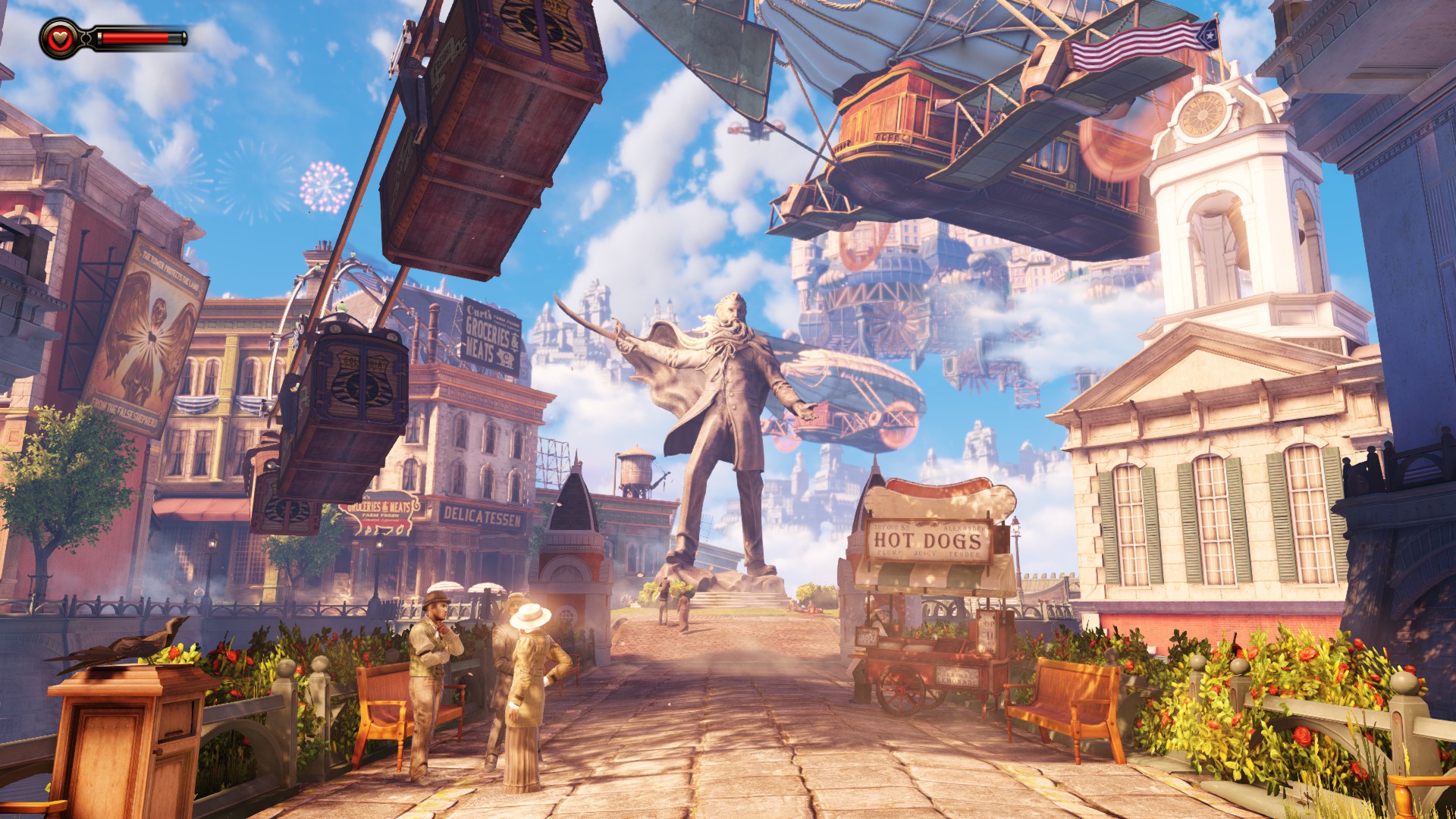
I heard and read reviews about this game, and there has been lots of posts, screenshots and gifs around the internet. Just form the beginning, the game can catch your eye by looking like this:


It's not only graphics, which are really good...is the world that they're showing you. A world of fantasy, a floating city with rails connecting sections, huge statues, a thriving population, shops, houses...all this mixed with steampunk technology. It looks awesome.

However, this is not all, by far. I started playing and was immersed in a complex and weird story, starting with an introduction that takes a long while before you even fire a single shot (apart from firing in little fair tents that have games of marksmanship). This introduction is incredible, makes you feel inside this place...but more important, makes you believe such a place exists.

Maybe a great part of what makes art amazing is its ability to create worlds that do not exist. You can see that in movies, in literature, in dance, even in music and paintings...they can show reality, but they can go further than that, and show you the realms of the imagination. These realms can be amazing, scary, dark, cheerful, modern, dream-like, happy...and in these realms you can make your own rules, in history, in economics, or even in physics.

Games are art, even if not recognized by everybody, and good games create such worlds while putting you in control of someone or something inside that world.

When these worlds are created with art, it is very important that they're created well. A bad painting, that messes up proportions just because of lack of skill will remind you that it's just a painting.  You may enjoy it, but reality will point out the problems it has, and you will return to your own world much faster. You can apply that with any other world-building work.

That's why world-building is very important. The most clear example you can find are novels. Novels, by its extension, have lots of time to create a world. It's hard to put a lot of details in a movie that last 90 minutes, but in a book of 500 pages you have time to develop a universe inside. Books have a lot more margin to define this world, which can be slightly or a lot different than our own.

And nothing will make a story lose its appeal as a badly-build world. I believe Terry Pratchett (or somebody commenting on his work) once mentioned that his created city of Ankh-Morpork submerges you in it because you don't need the protagonists to be there for it to work. If the hero was not walking around, doing hero stuff, its inhabitants would still work, and live, and eat food, and buy things, and all that. That created world is so rich that when the heroes stroll around it, it's easy to believe you're there with them. It makes sense internally. Does it matter that magic is real, the earth is flat, and that the sun orbits earth in there? No, because its consistent with itself, and it works...if you imagine a world described as it is in the books, you can see that it's solid, it has its own life.

Now, that may sound blasphemous...but let's have a look at Tolkien. Let's concentrate on Gondor. What does exactly that region do? It basically fights the Dark Lord, permanently, always at war for who knows how many years, all their people soldiers, all their people closed inside their walls. Now, Tolkien has great world-building skills, and this world is rich and varied. However, Gondor in particular makes little sense, and personally that's why it seems also like the most boring part of the books, when Gondor defends itself or attacks (when Rohan helps it's fun, but while there's only Gondor, it's boring), because I cannot help but wonder how the hell it's still standing, or how people manage to live there.

Now, you can maybe say that Tolkien explained these details in some other work, or that some things are implied without being said...however, I still think that Gondor, in the Lord of The Rings, is not well made, and it fails to stand on its own logic. People would not live there if it wasn't for the plot.

There are lots of lesser books that nevertheless grasped quite well this concept of World Building. For example, the Belgariad and the Malloreon are not greatly written, or very original...but its characters are much more alive than some of Tolkien's characters, and there's a lot of details to simple facts...like the fact that, if somebody's going to wage war, that someone is going to provide food for the troops, and then if you invest in some cheap food, you may get huge rewards...or, that a moving war front needs a constant supply of materials, which needs to follow you and form a chain with the origin of the supply. That gives a lot of coherence to the book.

Before I mentioned that movies do not have as much time for world-building...but that does not mean they should not have a good one. The easiest way to see that a movie is full of bullshit is if the world is rather inconsistent with itself. Take Star Wars prequels, where in a galaxy of millions of planets, that have billions of people and species in each planet, there's like 6 characters that are always present when something important occurs, no matter the place. That's laziness right there, and returns you to reality fast enough to scream bullshit.

Games are in a middle term, taking longer than movies but not being able to say as much as books do. In games, immersion is very dependant on that world-building. The first Bioshock game was impressive, the water rendering was amazing, physics involved in its movement were pretty awesome, and the introduction was very surprising...however, the supposed "city" did not seem a city at all. Even considering that an underworld city needs to have small corridors, it never felt like corridors, just a single endless corridor that railroaded you from place to place, with a few exceptions where you had a couple of different rooms to visit. Also, everybody was an enemy. For a city that was supposed full of people, even after a disaster, it felt empty, lifeless....and the fact that the corridors were not a labyrinth, or a grid, removed the feeling of being in a city, putting you back in reality and saying "Game with linear design".

Bioshock Infinite, in just the first hour of gameplay, shames the first Bioshock by showing how it's done: It moves you to a great city in the sky, with people, with attractions, shows, shops, toys, children and adults, subculture, rebellion, social problems, radio shows, music.....in general, life. You can see that people live there, you believe so, because it makes perfect sense, internally. The game still has a linear design, but by defending these flaws as part of life in there, such as the fact that private houses are closed, or that flying streets sometimes are not connected and may have timetables or change depending on the moment, makes you ignore the fact that you're basically moving from point A to point B in a straight line.

You feel in a city, with people living there, and you see that it does not require your character for it to make sense.

This is world-building when done well. Great stories and great art will always have great world-building. And Bioshock Infinite does it very well indeed....

Tuesday, 5 November 2013

Country Full Of Idiots

We've been rather busy these days, as it's to be expected. However, we're managing so far, and enjoying our new life :).

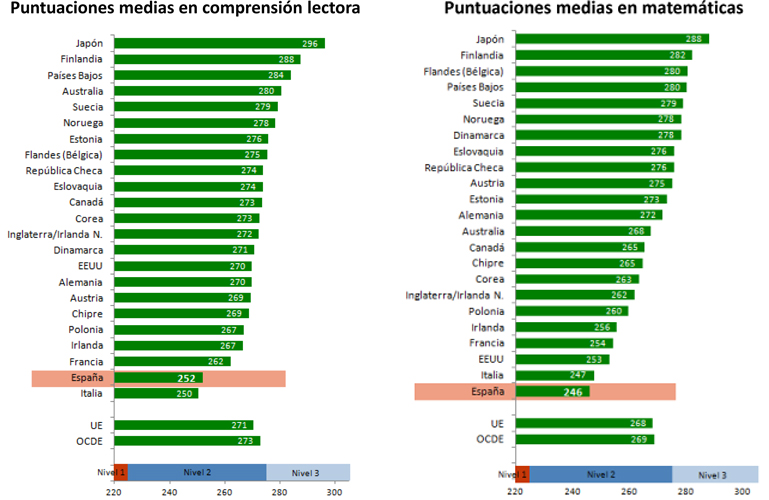
In this period, there was a piece of news that I wanted to comment when it appeared, but I didn't have the time or the inspiration at the time, so now it's rant time. The article can be summarized in these graphics:

The first one shows average results in reading comprehension by country. The second one shows results in mathematics.

Any statistic like this needs to be taken with some scepticism. One never knows the exact details of the tested group, and if everything was fair and really representative. However, we can believe real situation is something close to this.

What this shows is that Spain is full of idiots. Maybe great people, but still idiots. This explains why governments don't know how to solve problems. Even if part of what's happening right now was done on purpose by our government to help their rich friends, there are things that escape to their control, that show they're not smart enough to find a solution. This is paired with a stupid society, and the result is that the stupid society keeps voting for the same idiots all the time.

For a while, I've been thinking that there are two new laws we should use. In each case, I can think of a soft way to apply it, and a hard way.

The first step that we need to improve things in Spain is to demand by law that any person in the government or in parliament has some kind of university studies. If a person doesn't have high-level studies, it means that this person has not shown to have learnt any complex knowledge, ever. If University becomes a privilege for a few selected ones, this could be discussed, but if we manage to keep it public and available to most, this needs to be a requirement.

In the soft way to apply it, any university degree would work. It would at least show your ability to complete more things than compulsory studies, and it would show you're able to learn and understand harder concepts than what a 16-year old knows. One could argue that a degree does not grant you intelligence, or experience, or the best decision-making....but it shows that the person who got the degree has dedicated some effort to it, has learnt something, and that it has been enough to actually pass some subjects and (probably) do a final project. That's how it works in most real-life jobs, at first nobody knows you're good or bad, so the only thing you can give as a reference are your studies. Politicians should be no different.

The hard way would be to actually make some particular degree that is required to be part of the government or to be able to represent people in parliament. The logic, of course, is that having a degree in computer science or art history does not guarantee that you'll be any good at governing a country. The studies itself should include a wide range of things, but economics should be an important part of it. These studies could be considered "second cycle" studies, so you would need first some other degree, and then you could enlist in this course. Again, this does not guarantee a good government, but forces politicians to be smart and put effort into it, not like now where several high members of the main ruling parties and government do not even have studies.

The other step is more controversial, but I believe it's also necessary...basically, I would apply a law that limits the possibility of voting. Basically, with this law, being 18 years old would not give you the right to vote, showing that you're smart enough to vote would give you this right.

Of course this is a very conflicting topic. One could say that being smarter does not indicate that you know what's best for everybody else. There's also the point of identifying what's considered smart. To address how to consider if you're smart enough to vote, again there's two solutions.

The soft way would be to limit voting people to those who have finished successfully the compulsory education. The compulsory education in Spain is at a very low level, but at least it shows you have some degree of studies. Of course this could not be applied for everybody from the start, but a date could be arranged, as in all the people born after a certain year would be required to prove they have finished the compulsory education before they're allowed to vote.

The hard way would be to demand to pass a simple exam before you could vote. This would be done every four years, and it would just require a certain grasp in comprehension and mathematics for example, like in the two graphs I posted at the beginning. I know this system could be abused in different ways, but the current system is also abused, so it's not a big difference actually, the point being that bad governments will abuse whatever system is in place.

Now, before being accused of being anti-democratic, I want to explain my reasons. Basically, I believe that a person should only vote if they're capable of understanding what they're voting for. I'm not saying to force everybody to understand what they're voting for, I'm just saying to prove they could do so.

I really really doubt that a person who cannot comprehend a written text is able to really understand all the implications of an electoral program of a certain party. If someone cannot read, I would be happy to accept their vote as long as they could understand an electoral program read to them. Smarter people may not be able to always know what's best for everybody, and people who may not be as smart should also give their opinion...but as long as their opinion is really their opinion, and as long as they do have an opinion. If huge amounts of Spanish people don't understand anything after reading a text...how the hell are they deciding who to vote? They cannot know if it's good for them or not, because they did not understand it correctly in the first place.

Dumb people are easy to trick and mislead. Dumb people will not understand what are the real intentions of a party, even if they're not lying with their goals. Therefore, I don't see why dumb people should vote. Again, to define who is dumb and who is not, you would only need to prove you're able to read/listen and understand the text, and to do some easy mathematical calculations.

Opinions are great and everybody should have one, but there are things that are facts, and there are cases when something is clearly wrong or clearly right. This is also true in politics, not everything can be defended logically, some facts are true and some are false. Not everybody's opinion should count, if their opinion regarding an established fact has been proven wrong. Emotions are not enough to decide who to vote, they should be accompanied with the ability to reason about it, and then you could do whatever you want. I think I said it before, but you don't ask the village idiot about his opinion regarding your brain surgery. You would only do that if he somehow has proven to have a great amount of knowledge in this topic.....

So why do we let the idiots decide about our life's future, as if it was something minor where all the opinions are good, no matter how stupid?

Thursday, 10 October 2013

And Now We're Three

Our son Elay was born 3 weeks and a half ago.

On Monday, 16th of September, a day before we had a visit with the doctor, contractions started apparently and we went to the hospital. Contractions calmed down, but the doctors told us that everything was ready and it could start at any moment. Since even when it started it would take long (4-5 hours probably), I was sent back home, since in Russian hospitals nobody apart from the mother can enter in the normal rooms, and you can only be during the birth by special permission.

While at home, my wife called me and told me that after analysis, doctors decided that a C-section was necessary and actually urgent, and they were preparing her for it. In 2 hours it should be done, and he should be born. After waiting at home for more news, I finally was told that we were parents.

However, given the fragile condition anyone is after surgery, my wife had to be one day recovering before seeing our son. I could not really visit, so I had to wait to see them both. While working and waiting, my wife finally got to be with him, and sent some pics and videos. These days were a little bit frustrating, but the pics were really nice. Both were doing very well, and recovering very fast.

On Saturday they got permission to leave, so I finally went, together with Misha (who helped us by driving us in his car), and I finally met him. It was a very weird and exciting moment, and I noticed I had a stupid smile for quite a few minutes after holding him for the first time^^. After all, before this moment, I was not fully aware that I was a father...I knew I was, but I had not seen him or held him, so the feeling was similar as if he was still inside the belly...

Since that day we've been happily living together, and adapting to this new person^^.

First thing that we've noticed is that he's very funny to look at^^. He's still very small, of course, so he makes all this faces and movements. When he's hungry, he usually sticks out his tongue, makes little sounds and eats his hand. He keeps twisting his lips in weird ways, and he's very awake when not sleeping, looking everywhere. He focuses his eyes on you, crossing them a little and making a surprised face, and he's very funny^^. We have already taken some funny pics^^. At the same time we're trying not to hunt people to show them pics, and we're managing well in that aspect.

He's quite calm, if he's not hungry or uncomfortable he doesn't cry much (he just makes this single cry for attention when he's hungry or when he just woke up and we're not there with him, most of the time). We're lucky so far, and he seems to like to sleep deeply during the night (which means 4-5 hours, which for a baby is a lot), and until there's light, he just wakes up to feed a little and then he continues to sleep. During the day he's awake quite a lot of hours, just feeding and looking all around, with very curious eyes.

We're unsure about resemblances, but then again we're really bad with faces, or we don't care that much about these things...he clearly looks like his mother in lots of things, but recently we saw a picture of me when I was a newborn too, and since then we realise he has also a strong resemblance with me. He's too little anyway, and his features have changed a lot in just a couple of weeks (and will change even more).

He makes quite a lot of funny noises, grunts, little cries and other sounds that are quite cute^^. He moves his arms and legs not very coordinated, but you can notice when he's stressing about something,  because he squirms and moves all extremities. It's quite funny to see how he doesn't control them well enough yet, and sometimes he bothers himself with his hands, or pushes away my wife's breast while being stressed and trying to grab it with his mouth^^.

For the moment I still feel quite useless. My wife breast-feeds him (of course), so at night she needs to wake up, and I'm rather useless and go back to sleep (or not even wake up). Also, I'm still not good at changing his clothes and pampers, mainly because I'm too slow. Oh well...I do hold him, and walk him around the apartment when he's awake, and I managed to put him to sleep several times when he was not hungry. I try to speak with him in Catalan, explaining thingies that we're doing, and my wife is trying to use Russian, but some times we get back to English because we're used to it...

We're still learning lots of things, checking articles and books regarding what to do, what not to do, what's normal, what can we expect, and all those things. We try not to worry too much, and I think we're so far doing good in that side (for example, we know that when he's sleeping is normal to make sounds, and we don't take him any time he makes a little cry, we wait until he's really awake). Of course, things are still complicated and we don't know a lot, but we're trying to learn.

One very funny thing that we've noticed is that he hates not having some clothes on his body, and that he doesn't like baths at all. After the first bath, next time we undressed him he started to cry a lot and to make a devastated face. It was quite funny and heart-breaking at the same time, and we tried to calm him down and tell him everything is fine, but we couldn't help to laugh at his exaggerated reaction. Since then it has been the same every time we change his clothes, clean him while naked or prepare him for a bath...but well, we hope he may calm down and also learn to enjoy baths when he's more aware of his surroundings and he's able to hold his head without problems.

At this point our lives haven't changed much yet, only thing is that we're staying more at home. Since he's so small and sleeps so much, when he's sleeping we keep watching series and playing games, with the only difference being that we check on him, and that, of course when he's awake, we try to talk with him, and give him attention.

So far we're managing quite well with him, and we're starting to have fun together^^. It's quite a weird feeling, to have this little person to take care of and educate later on...but we're enjoying it a lot^^.

While we were adapting to this new life, here in Sochi it has been raining a lot. In the usual Russian way, several old and new roads "forgot" to have any kind of good drainage, and there was severe flooding (even when the rain itself was not that intense). We happily avoided it by taking care of our little person without moving from home, but I did have to go to Sochi once, to get papers from the hospital, and it was a terrible experience that I hope not to repeat...

Anyway, we're quite happy with our new lives, and waiting to discover more and more things together^^.